.avif)


Gibt es bereits Vorerfahrungen?
Do you have any experience?
Der Preis für eine Unterrichtseinheit beginnt bei 27€ und hängt von dem ausgewählten Paket ab.
We match you with a guitar teacher who fits your goals and the music you want to play, so you can start learning online with no waiting list. Right after you sign up you receive a no-obligation trial-lesson slot via WhatsApp.
After your free trial lesson you agree on goals, playing level and availability with your teacher, and your regular guitar lessons start right away.
Book your guitar lessons online whenever it suits you. The SIRIUS Workspace gives you unlimited access to exercises, chord sheets and recordings of your own sessions, so practice at home always has a clear direction.
Finding the right guitar teacher is the step where most people stall, so SIRIUS takes it off your hands. Tell us what you can play today, what you would like to be playing in six months and which evenings you can realistically protect, and we choose your teacher from a screened roster on exactly those three inputs rather than on who happens to live closest. Absolute beginners, players coming back after a twenty-year gap and self-taught guitarists who want the holes filled all fit. Wherever you are in Pittsburgh, the opening session costs nothing and arrives with a proposal naming the teacher we picked and the reason we picked them.
Everything runs one to one over video built for music, so an overdriven amp still sounds like itself and latency stays low enough for the two of you to count in together. There is nothing to install: both of your hands stay on camera inside a browser tab, on whichever device happens to be nearest. Acoustic or electric, child or adult, blues, rock, pop, country, metal or fingerstyle, the plan follows the music you actually care about. Between sessions the Workspace holds your tabs, your drills and video of you playing, so nothing has to be reconstructed from memory in Pittsburgh a week later.





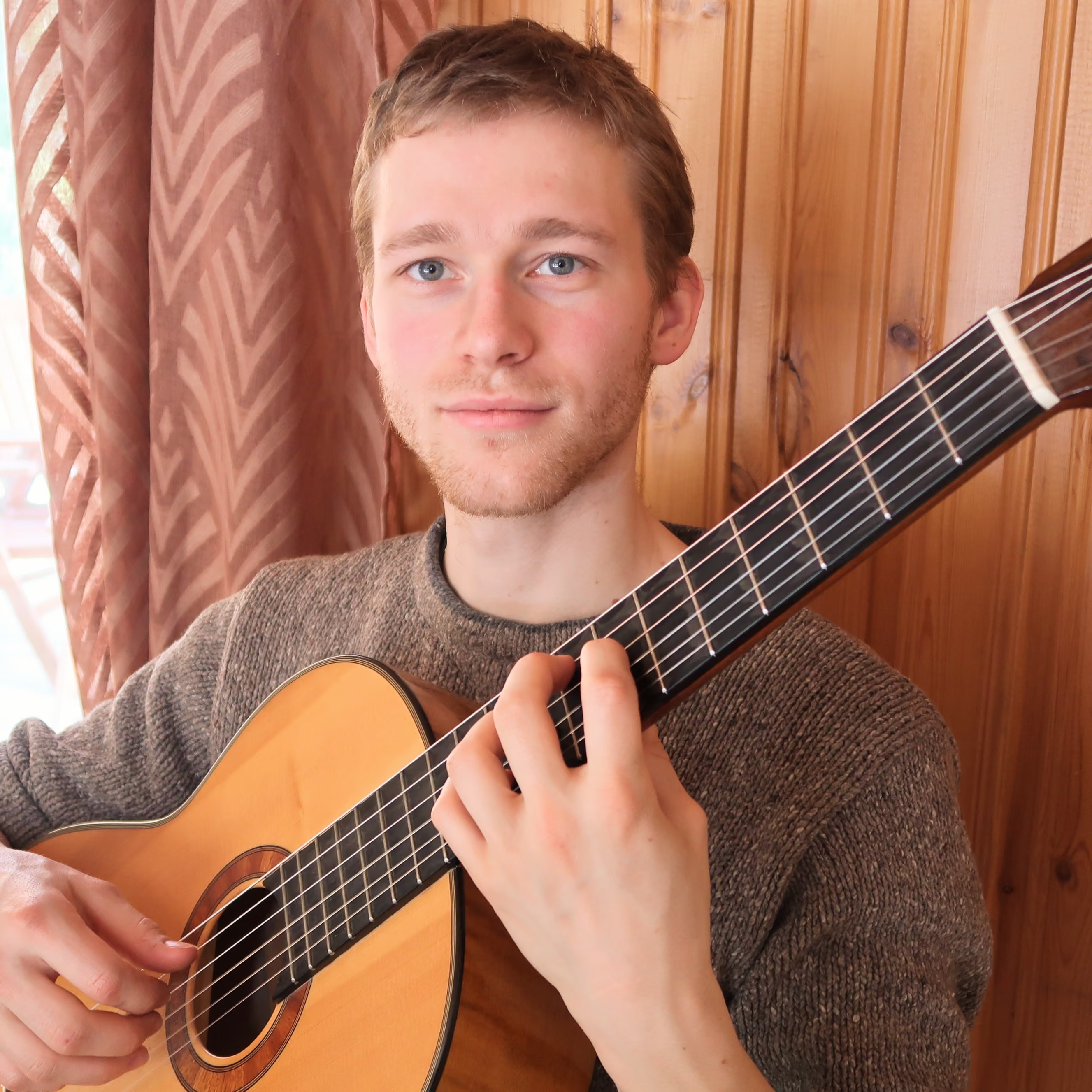
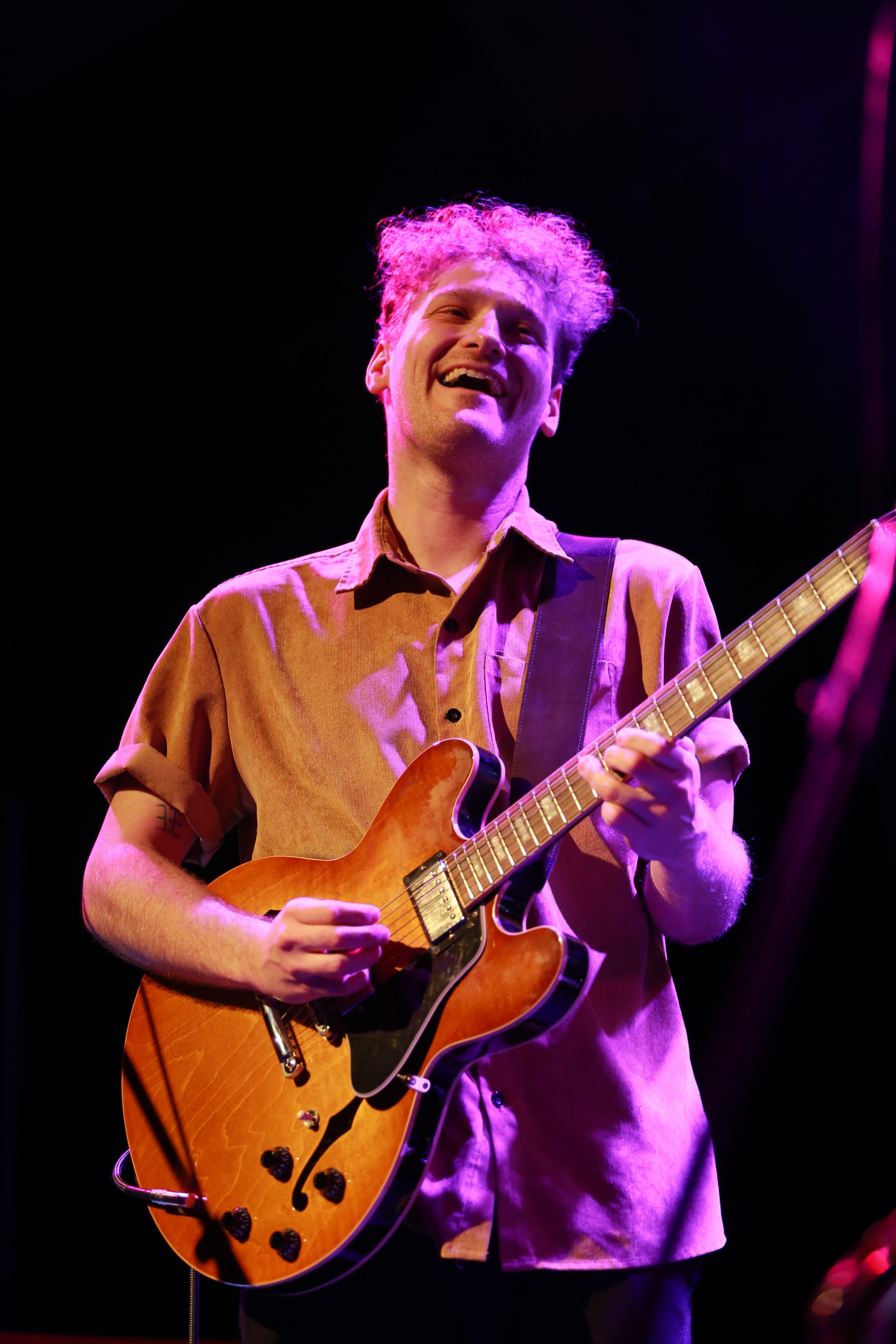
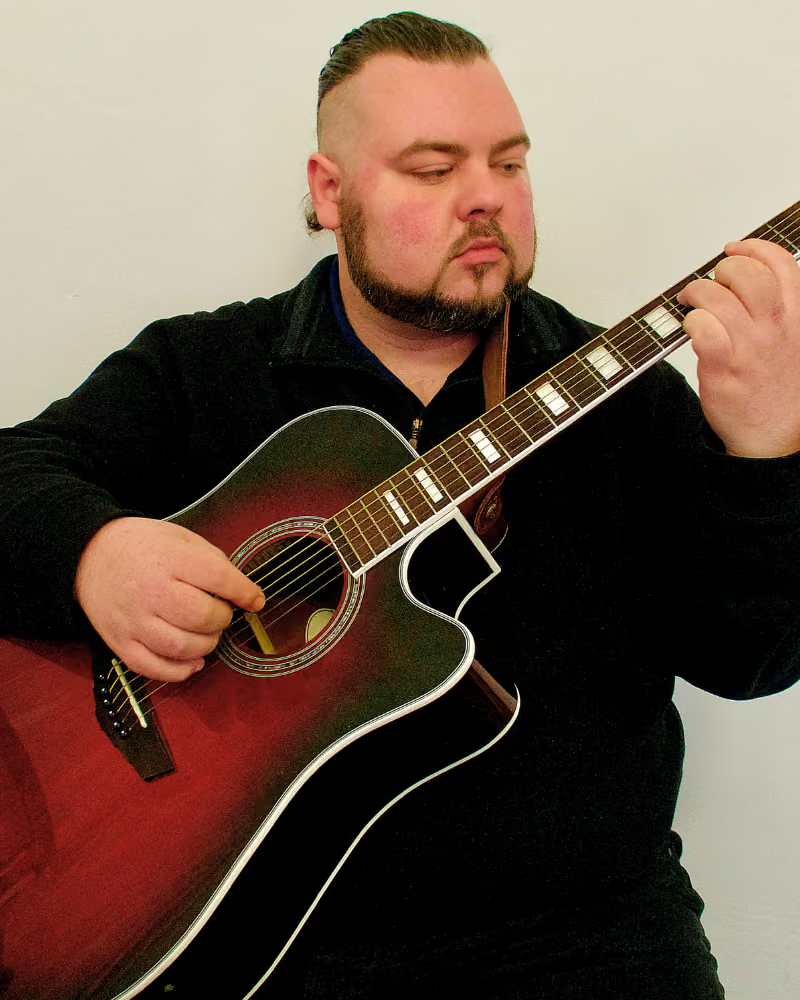


SIRIUS gives you one-to-one guitar lessons shaped around what you actually want to play, and everything from finding your teacher to payment runs through a single platform. Adding a lesson before a gig or moving a slot when the week gets busy takes a few clicks in the booking tool.
Learn the fundamentals of rhythm, chord theory and the fretboard, then apply them to the music you like, from rock and blues to pop, country, metal or fingerstyle. Acoustic or electric, your lessons always meet you at your level.
Alongside your lessons you get access to a digital Workspace built to make practice more efficient. In the SIRIUS Cloud you find the tabs, chord charts and targeted exercises your teacher assigns, all in one place. Lessons can be summarized automatically, and recordings let you go back to the moment a riff finally clicked.
You can also join monthly group sessions to play alongside other students, swap songs and pick up feedback, so you benefit from one-to-one coaching and from a community of players at the same time.

More hours = a better price per hour. Every plan: 45-min one-on-one lessons with vetted teachers.
Perfect to get started.
/hour
/hour
2 hours / month
$80.10 / month
$89.00 / month
with a 6-month membership
with a 3-month membership
↓ You save $53.40 with a 6-month plan
For lasting progress.
/hour
/hour
3 hours / month
$98.10 / month
$109.00 / month
with a 6-month membership
with a 3-month membership
↓ You save $65.40 with a 6-month plan
Faster progress, more practice.
/hour
/hour
4 hours / month
$116.10 / month
$129.00 / month
with a 6-month membership
with a 3-month membership
↓ You save $77.40 with a 6-month plan
All prices incl. VAT · Pause anytime
Many music students all over the world already trust SIRIUS.
“I've always played the same guitar chords and got much further into songwriting thanks to guitar lessons with SIRIUS”
.avif)
Louisa
guitar student
“Lisa always had to walk alone to her guitar teacher. Online guitar lessons are much more convenient.. ”
.avif)
Doro
Mother of a guitar student
“I finally really learned to play metal guitar with Robert. Power chords are just nice:)”
.avif)
steve
guitar student
“Learning guitar online quickly became boring without a teacher. Guitar lessons are super fun with Sirius.. ”
.avif)
Annika
Singing student
“I first had guitar lessons and have now started electric guitar lessons. It's great that you can easily switch... ”
.avif)
amir
Singing student
Gibt es bereits Vorerfahrungen?
Do you have any experience?
Treat this as market orientation rather than a SIRIUS quote. Private guitar teachers around Pittsburgh generally advertise roughly $30 to $45 for a half hour lesson and something like $50 to $85 for a full hour, with conservatory trained and long established names sitting at the top of that band while prepaid blocks shave a little off per session. Those are other people's published figures; any given teacher can of course land outside that range, so confirm directly before you book. What SIRIUS fixes is the process: your own rate is shown to you in advance, your opening session is a free trial, and no minimum term is attached to it.
It is not a problem at all, and it is the most common starting point we see. Month one stays deliberately narrow: two or three open chords, a way of holding the pick that will not have to be unlearned later, and getting between those chords in time rather than eventually. Most people can play through a recognizable song built on a handful of chords somewhere around week four to six. After that, progress is lumpy: long flat stretches broken by sudden jumps. The main thing a teacher buys you is shorter flat stretches, because they catch the one habit slowing you down before it hardens. Fifteen honest minutes on five days beats two hours once a week, every time.
Less than you would guess. You do need an instrument of your own at home, since the learning happens between lessons rather than during them, and SIRIUS neither supplies nor rents instruments. Beyond that: a tuner, free as a phone app; a handful of medium picks; a spare set of strings; and a metronome, also free on a phone. Going electric adds a small practice amp and a cable. A footstool or a strap helps you sit the same way every time, which matters more than it sounds. Everything else, pedals included, can wait until you know what you would want it to do.
Two things, mostly: time and choice. Guitar suits video better than most instruments, because the entire lesson is about what two hands are doing, and a camera pointed at the fretboard gives a teacher a better view than a chair three feet away. On top of that you stop losing an evening to a tunnel queue or a hunt for a parking space near a studio, and you are no longer limited to whoever happens to teach on your side of the rivers, so a specialist in jazz, or metal, or fingerstyle becomes reachable regardless of which Pittsburgh neighborhood either of you sits in. Every session is recorded into your Workspace afterwards, which an in person lesson simply does not give you. A free trial hour settles the question faster than any argument about it will.
You can, though it helps to know what you are signing up for. Jazz guitar rests on the same foundation as everything else, so a beginner still spends the first months on tidy chord changes, steady time and the geography of the fretboard before any of the harmony gets interesting. What differs is the direction of travel: seventh chords early, shell voicings in place of full barre shapes, and ear training taken seriously from day one. Given that this city produced George Benson and kept Joe Negri teaching the subject at Duquesne for 47 years, there is no shortage of teachers here who can walk a complete beginner down that road, and plenty who will mix it with blues and rock so it never feels like homework.
Gibt es bereits Vorerfahrungen?
Guitar in Pittsburgh comes with an unusually well documented pedigree. George Benson was born in the Hill District in 1943, was playing in unlicensed clubs by the age of eight and had recorded for RCA Victor by nine. Joe Negri, another native of the city, spent 47 years founding and chairing the jazz guitar program at Duquesne University's Mary Pappert School of Music before retiring in 2020. One became the player half the world imitates; the other turned the instrument into a subject you could take for credit.
MCG Jazz, at 1815 Metropolitan Street on the North Side, has run a 350 seat hall since 1987 and collected five Grammy Awards for records cut in that room. The louder end of town keeps its own stages: Thunderbird Cafe and Music Hall at 4053 Butler Street books touring and regional bands most weeks. And when the instrument misbehaves, Pittsburgh Guitars has held 1305 East Carson Street since 1979, with a full time repair bench for setups, fretwork and amp work.
One caution before you plan an evening around a marquee: several rooms filed under Pittsburgh are nothing of the kind. Mr. Smalls Theatre stands in Millvale, the Roxian Theatre is in McKees Rocks, and the chain music stores people mean when they say the one out past the parkway sit in Monroeville. Separate boroughs, separate drives.
Benson's trademark is doubling his guitar line with his voice, note for note. Strip away the showmanship and what remains is the sharpest self check a student owns: if you cannot sing a phrase back, you are not hearing it yet, only moving fingers in a memorized shape. Hum the line first, then hunt it down on the neck. An ear that leads the hands is the difference between reciting a solo and improvising one.
Geography makes the argument. The city is cut apart by three rivers and folded over steep hillsides, so a teacher five miles off as the crow flies still means a bridge, a tunnel and a queue. Anyone who has waited out the Squirrel Hill or Fort Pitt backup knows a twenty five minute drive is an aspiration, not a schedule. Add street parking in the older, denser neighborhoods and a weeknight slot across town eats the evening rather than the hour. Guitar lessons in Pittsburgh that open in a browser tab next to where the amp already lives delete the commute entirely.
Open chords come first, but the actual skill is the change between them: the silence while your hand relocates is what marks out a beginner. Then the strumming hand, where accents land and how to keep it swinging through beats you deliberately do not hit. Alternate picking follows, barre chords land once your grip can take them, and fingerpicking adds a second voice. Hammer ons and pull offs stop a phrase arriving one deliberate note at a time. You pick up tab plus enough standard notation to hold a conversation with players who use it. Further along, in a town with this jazz record, chord melody is a realistic destination: melody and harmony carried at once on six strings, precisely the trick Negri taught for half a century.
Both families get taught here and neither is the objectively right opening move. An acoustic needs no accessories and toughens the fingertips fast, at the cost of heavier strings that sting for a few weeks. Plugging in buys thinner strings and a narrower neck, gentler on new hands and the obvious route if blues, rock or metal pulled you in. Go that way and the amplifier joins the syllabus: what the gain control is really doing, why a fifteen watt combo beats a hundred watt one in a row house with shared walls, and where overdrive and reverb sit in the chain.
The point of practicing is eventually carrying the guitar out of the house. Butler Street offers the loud, forgiving end of things, where a rhythm part buried inside a band is a fine place to make your first public mistakes. The Metropolitan Street hall is the opposite room: seated, attentive, full of people who register your time before your speed. Watch a working guitarist's right hand for one set, then bring what you noticed to the next lesson.
Roughly everybody. Children once their fingers can press a string down cleanly, ideally on a short scale instrument. Teenagers arriving with the songs already chosen. Adults who quit at barre chords decades ago and find the muscle memory did not entirely leave. Retirees with no ambition to perform.
Start with the guitar you already own, whatever shape it is in. If it fights you, a proper setup at the repair bench on East Carson Street costs less than a month of lessons and will do more for your progress than any new instrument. Get that sorted, take the free trial hour, and you will know inside sixty minutes whether this is the year you finally learn the thing.
Bei SIRIUS kannst Du kostenlos eine Probestunde nehmen.
Die Anmeldung ist 100% kostenlos und unverbindlich.
Wir schicken Dir nach der Anmeldung Terminvorschläge für Deine gratis Probestunde.
Worauf wartest du noch?




.avif)