.avif)


Gibt es bereits Vorerfahrungen?
Do you have any experience?
Der Preis für eine Unterrichtseinheit beginnt bei 27€ und hängt von dem ausgewählten Paket ab.
We match you with a guitar teacher who fits your goals and the music you want to play, so you can start learning online with no waiting list. Right after you sign up you receive a no-obligation trial-lesson slot via WhatsApp.
After your free trial lesson you agree on goals, playing level and availability with your teacher, and your regular guitar lessons start right away.
Book your guitar lessons online whenever it suits you. The SIRIUS Workspace gives you unlimited access to exercises, chord sheets and recordings of your own sessions, so practice at home always has a clear direction.
Finding the right teacher is the part that stalls most people, and it is the part SIRIUS takes over for you. Tell us your level, the hours you can realistically protect and the players whose sound you would like to get closer to, and we pair you with an instructor from our vetted roster. Beginners in Nashville who have never fretted a note and returning players trying to clean up their chord changes both get a plan built around where they actually are. Sign up for a free trial lesson and you will receive a session proposal with the teacher we think fits you best.
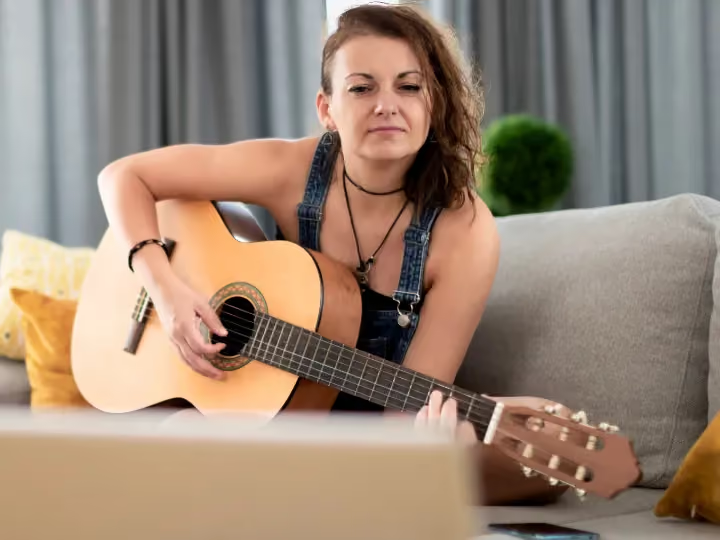
Our teachers work on acoustic and on electric, with children, teenagers and adults, from absolute beginners to players who already gig. The platform was built for music lessons rather than meetings, so the audio holds up and there is nothing to install beforehand. That means a lesson in Nashville can happen wherever your guitar already lives, on a laptop, a tablet or a phone. You move at your own pace, from your first clean chord change to your first solo.





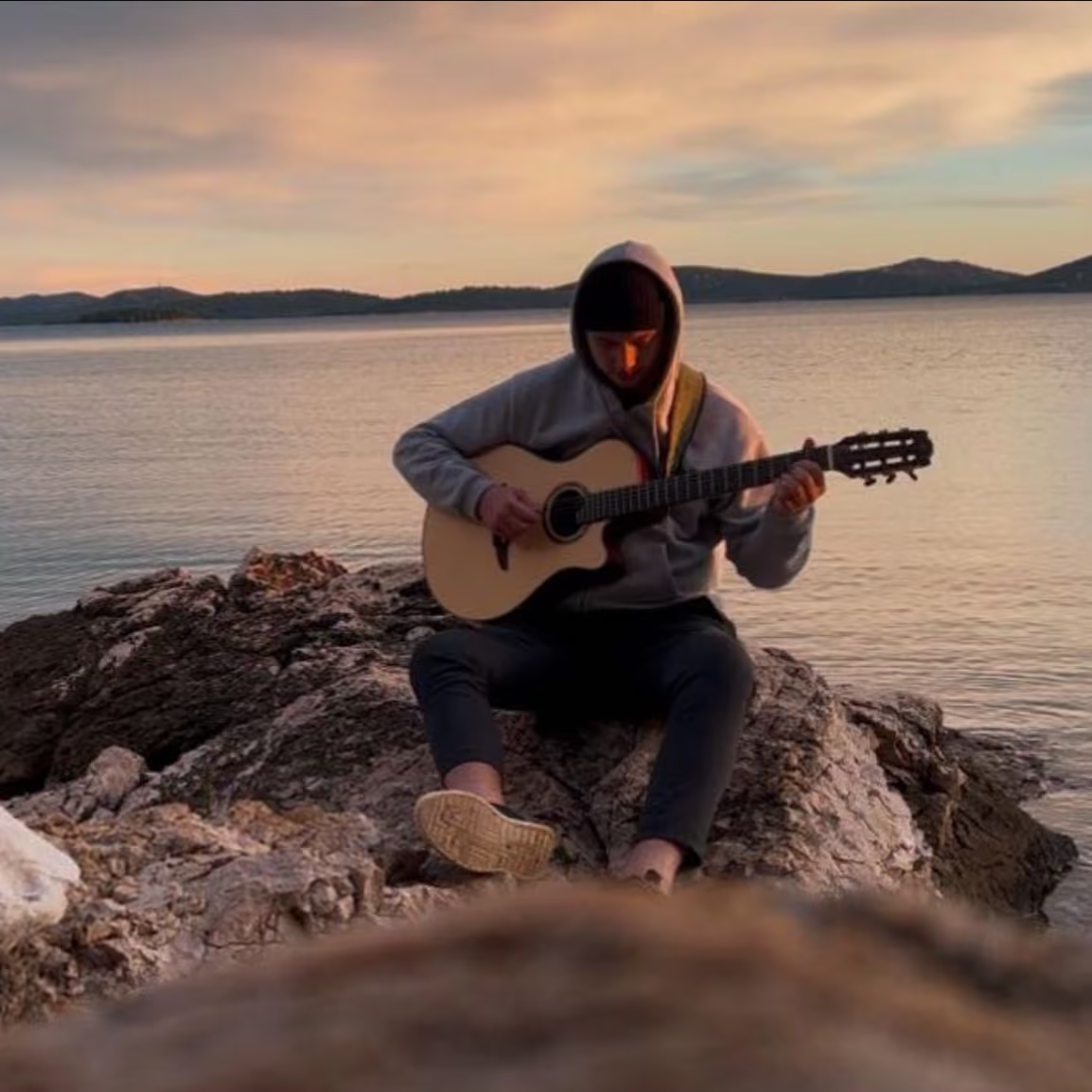


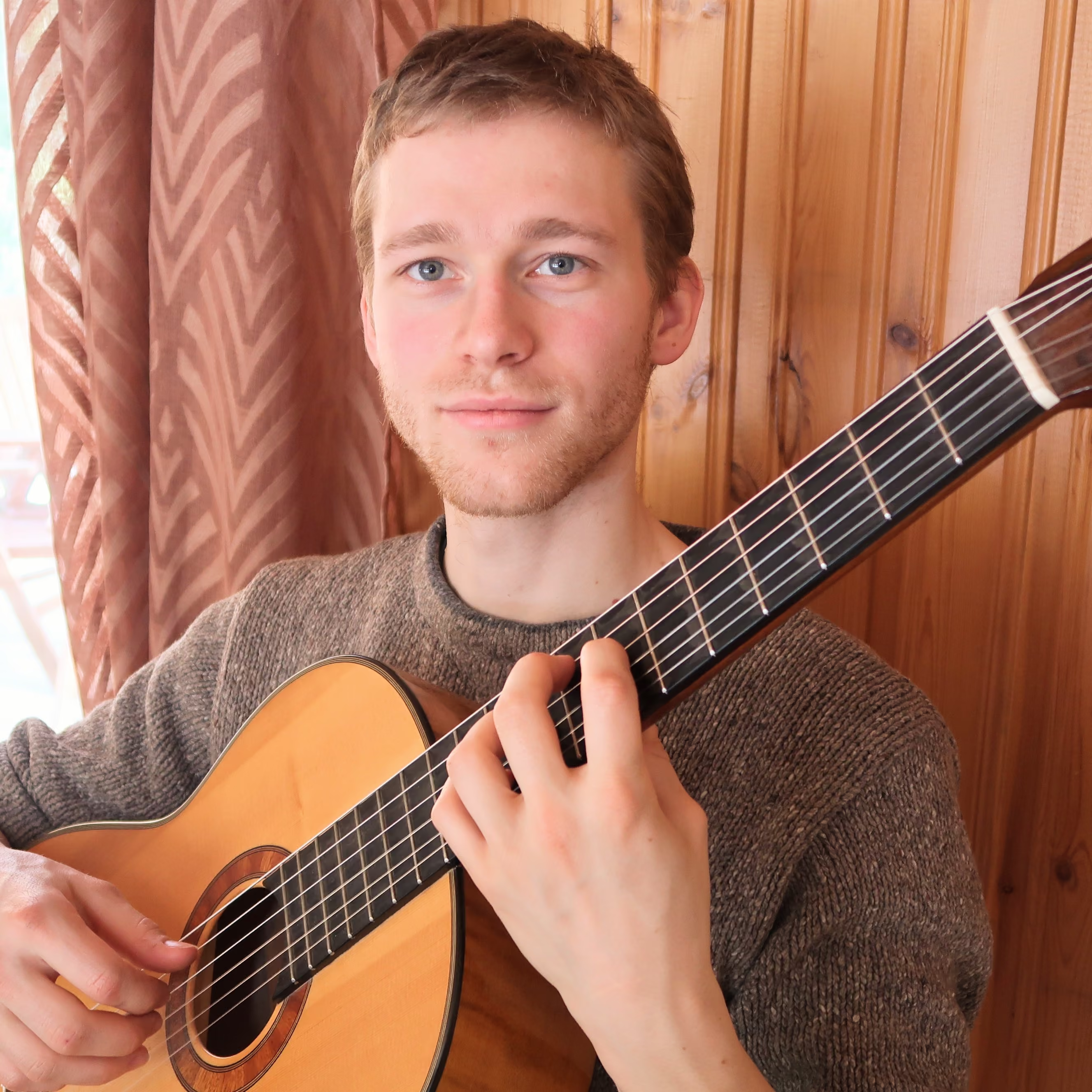
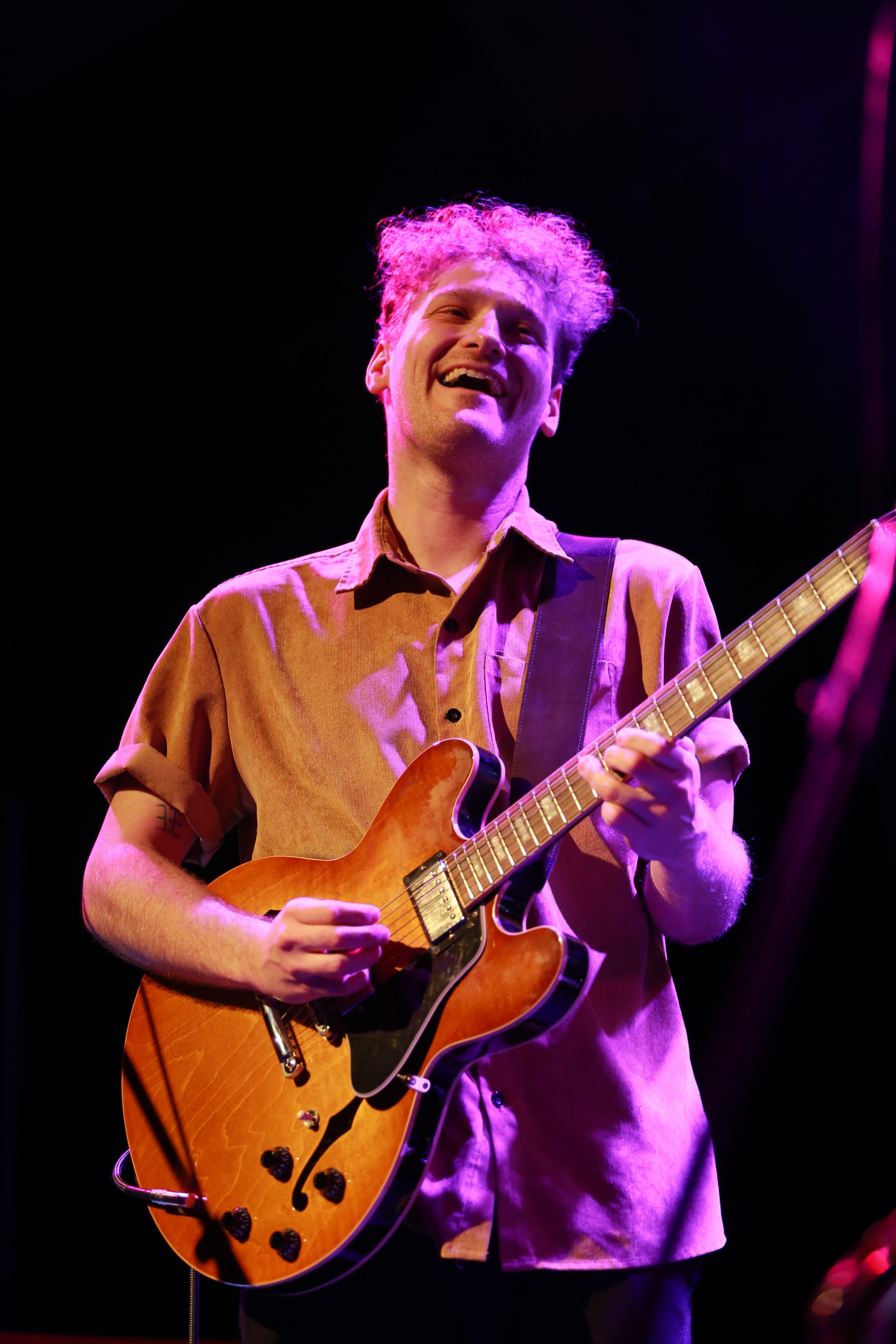



SIRIUS gives you one-to-one guitar lessons shaped around what you actually want to play, and everything from finding your teacher to payment runs through a single platform. Adding a lesson before a gig or moving a slot when the week gets busy takes a few clicks in the booking tool.
Learn the fundamentals of rhythm, chord theory and the fretboard, then apply them to the music you like, from rock and blues to pop, country, metal or fingerstyle. Acoustic or electric, your lessons always meet you at your level.
Alongside your lessons you get access to a digital Workspace built to make practice more efficient. In the SIRIUS Cloud you find the tabs, chord charts and targeted exercises your teacher assigns, all in one place. Lessons can be summarized automatically, and recordings let you go back to the moment a riff finally clicked.
You can also join monthly group sessions to play alongside other students, swap songs and pick up feedback, so you benefit from one-to-one coaching and from a community of players at the same time.

More hours = a better price per hour. Every plan: 45-min one-on-one lessons with vetted teachers.
Perfect to get started.
/hour
/hour
2 hours / month
$80.10 / month
$89.00 / month
with a 6-month membership
with a 3-month membership
↓ You save $53.40 with a 6-month plan
For lasting progress.
/hour
/hour
3 hours / month
$98.10 / month
$109.00 / month
with a 6-month membership
with a 3-month membership
↓ You save $65.40 with a 6-month plan
Faster progress, more practice.
/hour
/hour
4 hours / month
$116.10 / month
$129.00 / month
with a 6-month membership
with a 3-month membership
↓ You save $77.40 with a 6-month plan
All prices incl. VAT · Pause anytime
Many music students all over the world already trust SIRIUS.
“I've always played the same guitar chords and got much further into songwriting thanks to guitar lessons with SIRIUS”
.avif)
Louisa
guitar student
“Lisa always had to walk alone to her guitar teacher. Online guitar lessons are much more convenient.. ”
.avif)
Doro
Mother of a guitar student
“I finally really learned to play metal guitar with Robert. Power chords are just nice:)”
.avif)
steve
guitar student
“Learning guitar online quickly became boring without a teacher. Guitar lessons are super fun with Sirius.. ”
.avif)
Annika
Singing student
“I first had guitar lessons and have now started electric guitar lessons. It's great that you can easily switch... ”
.avif)
amir
Singing student
Gibt es bereits Vorerfahrungen?
Do you have any experience?
As general market orientation rather than a SIRIUS quote: private guitar teachers around Nashville commonly ask somewhere in the region of $30 to $50 for a half hour and roughly $50 to $95 per hour. The upper end reflects how many working session and touring players teach on the side here, and rates also move with lesson length and whether anyone has to travel. Treat those numbers as a rough guide and confirm with the individual teacher. With SIRIUS you see your own rate before you book anything, the first lesson is a free trial, and no long-term contract is involved.
Almost certainly not. Sore fingertips are the normal price of the first few weeks, and calluses usually form within two to four weeks of short, regular practice. Two things speed it up: shorter sessions more often rather than one long one, and a guitar that is set up properly. If the strings sit high off the neck you are fighting the instrument, and a setup at a shop with a repair bench will make a modest guitar dramatically easier to play. Stop before your fingers get raw, and mention the discomfort to your teacher so they can check your hand position.
Fifteen to twenty focused minutes on most days will take you further than one long session on the weekend, because chord changes and picking accuracy are built through repetition rather than duration. What matters more is knowing what to work on, which is why your teacher assigns specific drills instead of leaving you to improvise. The recordings and exercises in your Workspace mean you can replay exactly how something was demonstrated, so you practice the right movement rather than reinforcing a mistake for a week.
Yes, and the format tends to suit gigging players well. Your teacher watches both hands on camera and corrects your fretting, picking and timing while you play, exactly as they would sitting next to you. Because there is no drive attached, a lesson fits between a day job and a rehearsal, and slots can be moved when a session or a run of shows lands on top of them. Anything you want to revisit is recorded, so a chart or a solo you worked on in Nashville on Tuesday is still there on Sunday. The free trial lesson is the simplest way to test whether it works for you.
No. Most guitarists work from tab and chord charts, both of which you can read within a lesson or two, and plenty of accomplished players never learn standard notation at all. Your teacher will introduce as much notation as your goals actually require, which for many students is very little. It is worth knowing that the number charts widely used by players in this city are not standard notation either, they are chords written as scale degrees, so understanding how a key is built will do more for you than sight-reading ever will.
Gibt es bereits Vorerfahrungen?
Nashville is one of the few places where the guitar is a job description. Brent Mason, a Chet Atkins protege, has played on well over a thousand albums and sits on Guitar World's list of the ten best session guitarists of all time. Tom Bukovac has been based here since 1992, has more than 1,200 records behind him, and teaches through a channel players study frame by frame. Those careers were built on getting a part right in three takes. That standard trickles down, and it changes what learning here feels like.
The storefronts make the case. Gruhn Guitars has dealt in fine fretted instruments since George Gruhn opened in 1970 and now sits at 2120 8th Avenue South, repair bench behind the showroom. A few blocks up the same street, Carter Vintage Guitars has occupied 606 8th Avenue South since Walter and Christie Carter founded it in 2012. Fanny's House of Music at 1101 Holly Street stocks electrics, acoustics, amps and pedals and takes in repair work. The Gibson Garage at 209 10th Avenue South keeps a stage inside the store. Walk into any of them with a cheap first guitar and a buzzing fret and you are still taken seriously.
Your lessons cover the fundamentals any guitarist needs: open chords first, then the much harder skill of switching between them without a gap; strumming patterns and where the accent lands; barre chords once your grip can take the pressure; fingerpicking; hammer-ons, pull-offs and bends. Tab arrives early, since that is what players actually pass around, and enough standard notation follows that you can talk to musicians who read.
There is also a local dialect worth picking up. In the late 1950s Neal Matthews Jr. of the Jordanaires devised a shorthand that writes chords as scale degrees rather than letter names, so a room full of players could change key on the spot. Charlie McCoy expanded it and Chas Williams published it in 1988, and the Nashville Number System now turns up on charts all over town. Ask your teacher to bring numbers in alongside your chord shapes and the fretboard stops being a pile of memorized grips and starts behaving like a system.
Neither is the correct answer; it depends on the fit. A steel-string acoustic builds hand strength fast, needs nothing plugged in, and suits songwriting and fingerstyle. An electric has lighter strings that are kinder to new fingertips, and it puts bending and vibrato, the working vocabulary of country lead playing, within reach far sooner. The trade-off is gear: an amp is effectively a second instrument, and learning what its controls do belongs in the lesson.
Guitar lessons in Nashville that run in a browser tab also spare you the drive across town at six in the evening, and there is nothing to install before your first session.
Practice benefits from a destination. The Station Inn at 402 12th Avenue South has booked bluegrass and roots music since 1974 and still runs nightly, doors at seven and music at nine, flatpicking territory where the guitar carries the tune instead of the background. The Basement East at 917 Woodland Street has hosted local and touring acts since April 2015 across rock, country and everything adjacent. Centennial Park runs the free Musicians Corner series, in its seventeenth year in 2026. AmericanaFest scatters showcases across club stages citywide every September, with the 2026 edition set for September 15 to 19. None of these is a Broadway honky-tonk, and none of them is programmed for tourists.
Kids who need a three-quarter-size body before a full one fits. Parents who played a little before children arrived and want the instrument back. People who moved here for the music and feel underqualified at every jam. Working musicians who can hold a rhythm part together and want to understand what the lead player is doing. Beginners get patience; experienced players get someone who can hear what is genuinely holding them back.
Nobody's first purchase is a pre-war Martin lifted out of a case on 8th Avenue South. Take guitar lessons in Nashville with whatever instrument is already sitting in your closet, spend one free hour with a teacher who plays the music you actually listen to, and let those shop windows stay a reward for later.
Bei SIRIUS kannst Du kostenlos eine Probestunde nehmen.
Die Anmeldung ist 100% kostenlos und unverbindlich.
Wir schicken Dir nach der Anmeldung Terminvorschläge für Deine gratis Probestunde.
Worauf wartest du noch?




.avif)