
.avif)


Do you have any experience?
Hast du bereits Erfahrung?
Tell us your goals and we pair you with a SIRIUS-vetted piano teacher who fits them, so you can start playing online at a time that fits your week.
After the free trial lesson you agree on times directly with your teacher, and you can move a session whenever work, school or family gets in the way.
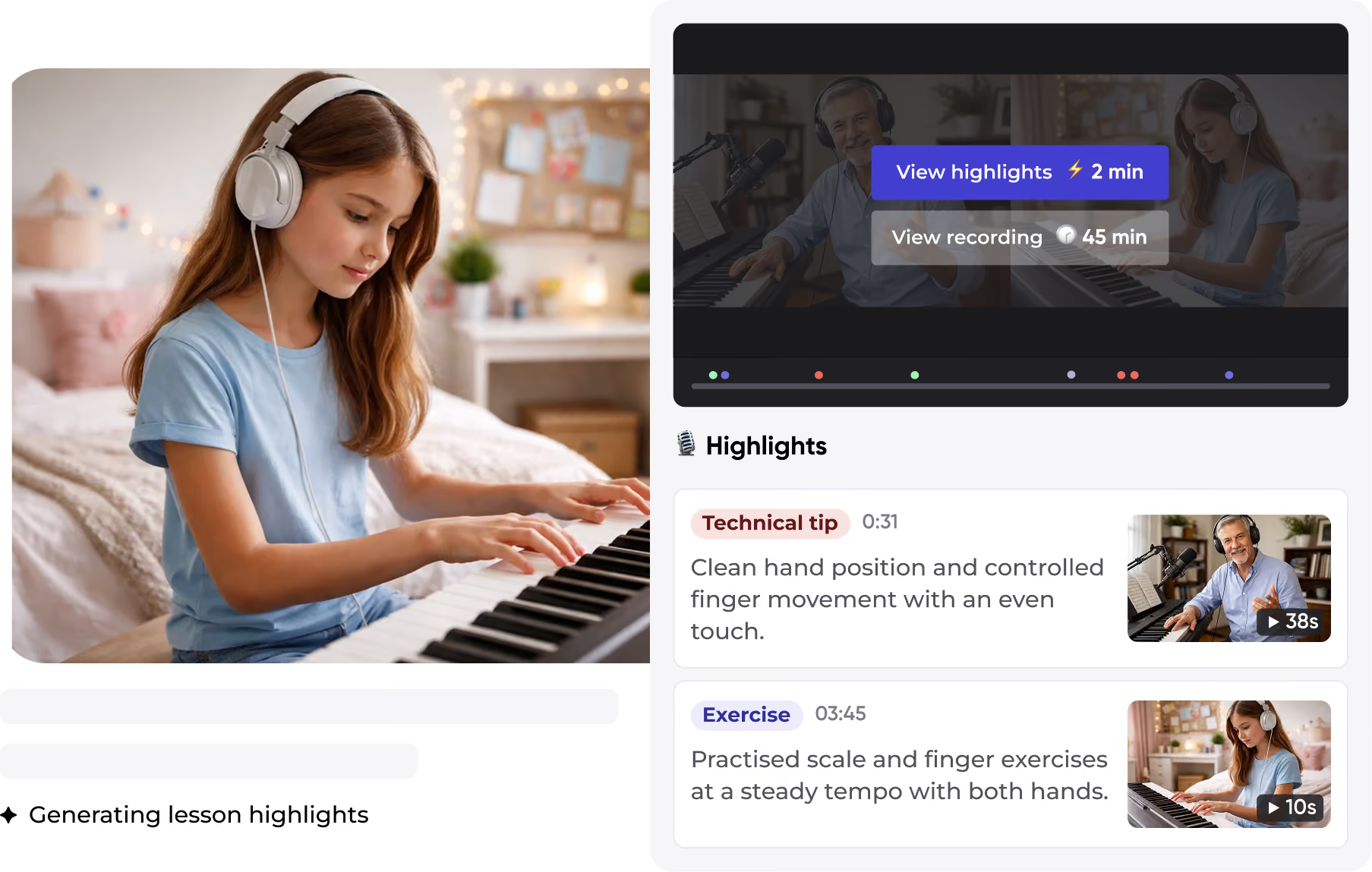
The SIRIUS Workspace holds your sheet music, the exercises your teacher assigns and the recordings of your sessions, so the days between lessons stay productive.
Do you want to learn piano and find a piano teacher in New York? We work with more than 150 SIRIUS-vetted music teachers and match you with the one who suits your goals, whether you are pressing your first keys or returning to an instrument you left behind years ago. Classical repertoire, pop songs, jazz voicings or the styles you grew up hearing: you decide what your lessons are about.
Our teachers help you build technique that lasts instead of habits you later have to unlearn. The SIRIUS platform was developed for online instrumental teaching, so sound quality stays clear enough to hear touch and pedaling, and you can join from anywhere in New York without installing extra software.
.avif)





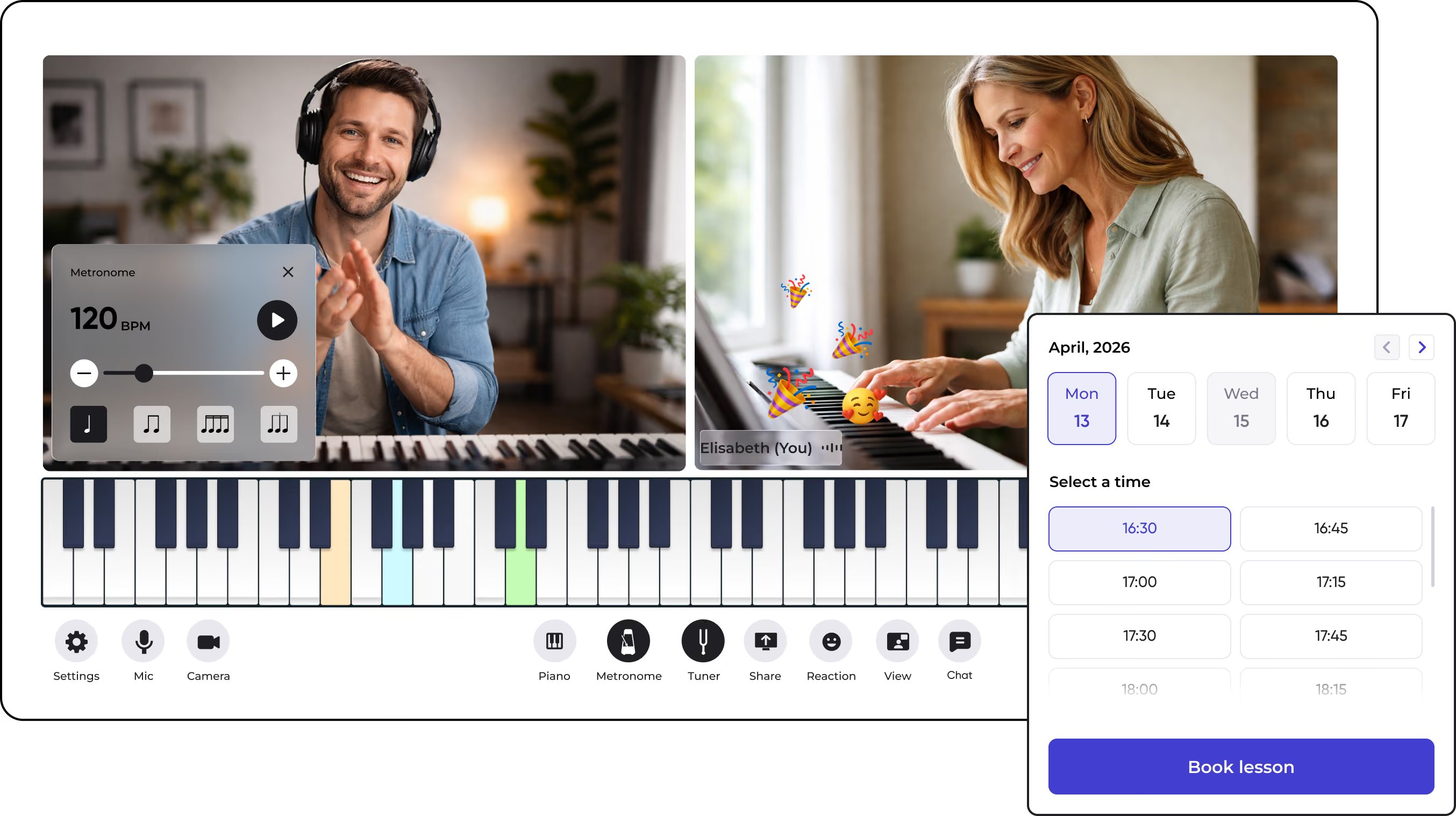
SIRIUS gives you one-on-one piano lessons shaped around you, and everything from finding your teacher to payment runs through one platform. Adding an extra session before a recital or moving a lesson to a quieter week takes a few clicks in the booking tool. If you do not own an instrument yet, you can rent a keyboard through us and start right away.
In your lessons you learn to read both clefs, understand how chords are built, keep a steady pulse and use the sustain pedal so it clarifies rather than blurs your playing. Music theory arrives when it explains something under your hands, never as homework for its own sake.
Alongside your lessons you get the SIRIUS Workspace, a digital home for everything you are working on. Sheet music, fingering notes and the exercises your teacher assigns stay in one place, lessons can be summarized automatically so you can look up what you covered, and recordings of your sessions let you watch your own hands and check posture, tempo and dynamics between lessons.
You can also join monthly group sessions with other players, hear how they approach a piece and get feedback beyond your one-on-one lessons. For many students that mix of private coaching and community is what keeps daily practice going.
More hours = a better price per hour. Every plan: 45-min one-on-one lessons with vetted teachers.
Perfect to get started.
/hour
/hour
2 hours / month
$80.10 / month
$89.00 / month
with a 6-month membership
with a 3-month membership
↓ You save $53.40 with a 6-month plan
For lasting progress.
/hour
/hour
3 hours / month
$98.10 / month
$109.00 / month
with a 6-month membership
with a 3-month membership
↓ You save $65.40 with a 6-month plan
Faster progress, more practice.
/hour
/hour
4 hours / month
$116.10 / month
$129.00 / month
with a 6-month membership
with a 3-month membership
↓ You save $77.40 with a 6-month plan
All prices incl. VAT · Pause anytime
Do you have any experience?
Hast du bereits Erfahrung?
Many music students all over the world already trust SIRIUS.
My daughter was able to start singing lessons the very next day, and the sessions with Leonie are fantastic!

Anita
Mother of a singing student
David explained music theory to me in such a clear, vivid way. I’ve been at it for 4 months now and I love it…

Robert
Piano student
I always used to shy away from sheet music and music theory. Now, learning the piano is actually fun for me…

Christiane
Piano Student
I actually just wanted to learn a few campfire songs on the guitar, but I’ve been at it for over half a year now. Highly recommended!

Alex
Guitar student
Julianna is fantastic! The professional voice training has completely transformed my stage presence…

Beatrix
Vocal student
Expect $40 to $90 per hour. Where you land inside that band comes down to the individual teacher: years of teaching, the training behind them, and whether you book single sessions or a standing weekly slot. SIRIUS shows each teacher's rate up front, there is no contract to sign, and the trial lesson costs nothing, so you can check the fit before any money changes hands.
With twenty focused minutes on most days, a first short piece using both hands usually arrives somewhere between month two and month four. Something a friend would actually recognize tends to follow by around month six. Frequency matters far more than talent here, and your teacher keeps choosing pieces that sit just ahead of your current level so the next one stays within reach.
Yes. On a digital instrument you plug in headphones and the room hears only the soft knock of the keys. With an acoustic piano, keep practice to daytime and early evening; the city's own noise guidance simply asks that instruments be played at a reasonable volume, especially at night and early in the morning. A rug underneath and a little distance from a shared wall help too.
Very little, and some things improve. Your teacher sees your hands close up on screen, and SIRIUS built its browser software for musical sound rather than speech. What is missing is a second body at the bench, so your teacher demonstrates and describes instead. In exchange, finding a teacher no longer depends on subway lines.
No. People start in their sixties and seventies every year, and adults often move quickly through reading, counting and musical structure because they already think in patterns. Hands stay flexible enough with steady, unhurried practice and sensible session lengths. What really changes with age is which music motivates you, which is exactly why lessons are one-to-one and built around the pieces that pull you to the keyboard.
Hast du bereits Erfahrung?
Hast du bereits Erfahrung?
In New York the instrument is never far away. Steinway & Sons still builds pianos by hand at One Steinway Place in Astoria, Queens, and says they have been made that way since 1880. At 178 Seventh Avenue South, the Village Vanguard has been open since 1935 and all-jazz since 1957, and it is where Bill Evans, Scott LaFaro and Paul Motian recorded on June 25, 1961. Time and floor space are the scarce parts.
The New York Philharmonic plays at David Geffen Hall, which reopened on October 8, 2022 after a renovation that brought the room down to roughly 2,200 seats and renamed the auditorium the Wu Tsai Theater; Gustavo Dudamel becomes its Music and Artistic Director in September 2026, after a season as Music & Artistic Director Designate. Carnegie Hall, open since 1891, runs three rooms under one roof: the 2,804-seat Stern Auditorium, 599-seat Zankel Hall and the 268-seat Weill Recital Hall. Teaching runs just as deep: Juilliard has been at Lincoln Center since 1969, Manhattan School of Music was founded in 1918 by Janet Daniels Schenck, and the Mannes School, started by David and Clara Mannes in 1916, sits inside The New School's College of Performing Arts. A private piano teacher in New York works against that backdrop, whether you are eight or fifty-eight.
Piano study starts with the body: how you sit, where the bench goes, how the arm carries weight into a key instead of the finger poking at it. From there come the two staves at once, key signatures, the shape of major and minor chords, and enough theory to explain why a progression moves as it does. You practice hands separately before joining them, count out loud, and meet the damper pedal later than most people expect. Your teacher builds the practice plan: what to repeat, how slowly, and how to know a passage is fixed.
New York's building code generally requires habitable rooms other than kitchens to be at least 8 feet in any plan dimension and 80 square feet in area, and the instrument has to fit inside that. A Yamaha b1 console upright measures 58.3 inches wide and 21.3 inches deep, and weighs 384 pounds. Add a duet bench plus a foot and a half of leg room, and the piano claims close to four feet out from the wall across a five-foot stretch. In a room that only just meets that minimum, the piano and its bench take about a quarter of the floor. A slim digital rewrites the arithmetic: a Casio Privia PX-S1100 is 9.1 inches deep and about 25 pounds; a Yamaha P-145 is 10.6 inches deep, or 12.5 inches on its own stand. Bench and player included, you stay under three feet out. When no wall is free, only the digital works in front of a window, where an upright would have to clear the radiator, the blind cord and the air conditioner; an interior wall puts more mass between you and a neighbor. The bench is the piece everyone forgets; it needs floor of its own either way. And when guests arrive, a 24-pound board lifts off a folding stand and disappears behind the sofa; 384 pounds of upright does not. If you would rather not buy before the habit takes hold, a rented or second-hand digital keeps the outlay small.
Lessons run in your browser on software SIRIUS built for the job, tuned so a piano's dynamics and decay survive the connection instead of being flattened into ordinary call audio, with nothing to install. Private teaching here goes for $40 to $90 per hour; with SIRIUS there is no contract, and the first lesson is free, so you can test the format first. Your teacher comes from more than 150 SIRIUS-vetted music teachers, matched around what you already play, where you want to end up, and the repertoire that keeps you at the bench. Between sessions you keep an online workspace holding your sheet music, recordings from the lesson and your teacher's notes, so practice at home picks up where the hour stopped.
Studying online does not cut you off from the city; it gives back the commute. Harlem produced the stride tradition, and Carnegie Hall's own history of the style credits James P. Johnson with originating it, followed by Willie "The Lion" Smith, Charles "Luckey" Roberts and Fats Waller. Jazz at Lincoln Center programs Frederick P. Rose Hall at Broadway and 60th Street, with Wynton Marsalis, its Managing and Artistic Director, leading the artistic side through the 2026–27 season. The Vanguard has given Mondays to the same big band since 1966, more than 2,700 nights on. Lessons reach students anywhere in New York, NY: what you work on Tuesday you can hear live on Thursday.
Children can begin once they sit through a focused half hour and recognize letters. Adults arrive as complete beginners, as returners who stopped at twelve, and as readers who never learned to voice a chord. Lessons are one-on-one, so a seven-year-old finding middle C and a forty-year-old working through a Chopin prelude get entirely different hours.
Picture yourself six months from now, home on a Wednesday, playing something through twice before dinner because you feel like it. Book your free trial lesson and see how the first hour feels.
Bei SIRIUS kannst Du kostenlos eine Probestunde nehmen.
Die Anmeldung ist 100% kostenlos und unverbindlich.
Wir schicken Dir nach der Anmeldung Terminvorschläge für Deine gratis Probestunde.
Worauf wartest du noch?



.avif)
.avif)


