.avif)


Gibt es bereits Vorerfahrungen?
Do you have any experience?
Der Preis für eine Unterrichtseinheit beginnt bei 27€ und hängt von dem ausgewählten Paket ab.
We match you with a guitar teacher who fits your goals and the music you want to play, so you can start learning online with no waiting list. Right after you sign up you receive a no-obligation trial-lesson slot via WhatsApp.
After your free trial lesson you agree on goals, playing level and availability with your teacher, and your regular guitar lessons start right away.
Book your guitar lessons online whenever it suits you. The SIRIUS Workspace gives you unlimited access to exercises, chord sheets and recordings of your own sessions, so practice at home always has a clear direction.
Most people hunting for a guitar teacher in Aurora start by working through whichever studios sit within a tolerable drive, then settle for the first free slot on offer. SIRIUS reverses that order. Say where your playing currently stands, which evenings genuinely survive contact with your week, and which music you would actually want to play one day, and back comes an instructor drawn from a roster we check ourselves. A nine-year-old on a three-quarter acoustic and a returning player who stalled out fifteen years ago are two different jobs, and each plan starts from the truth. Request the free trial and the proposal that comes back has a teacher's name on it.
Teaching is one to one and happens online, on steel-string, nylon-string or electric, and it works the same for kids, teenagers and adults. Your teacher keeps a camera on the fingerboard, follows both hands while you play, and calls a halt the moment a bad habit shows itself, the way any decent instructor would from the next chair. A lesson runs inside a normal browser tab, so nothing has to be installed before your first chord. What gets set during the hour is waiting in your Workspace afterwards, which is how the days between lessons in Aurora stop being guesswork.





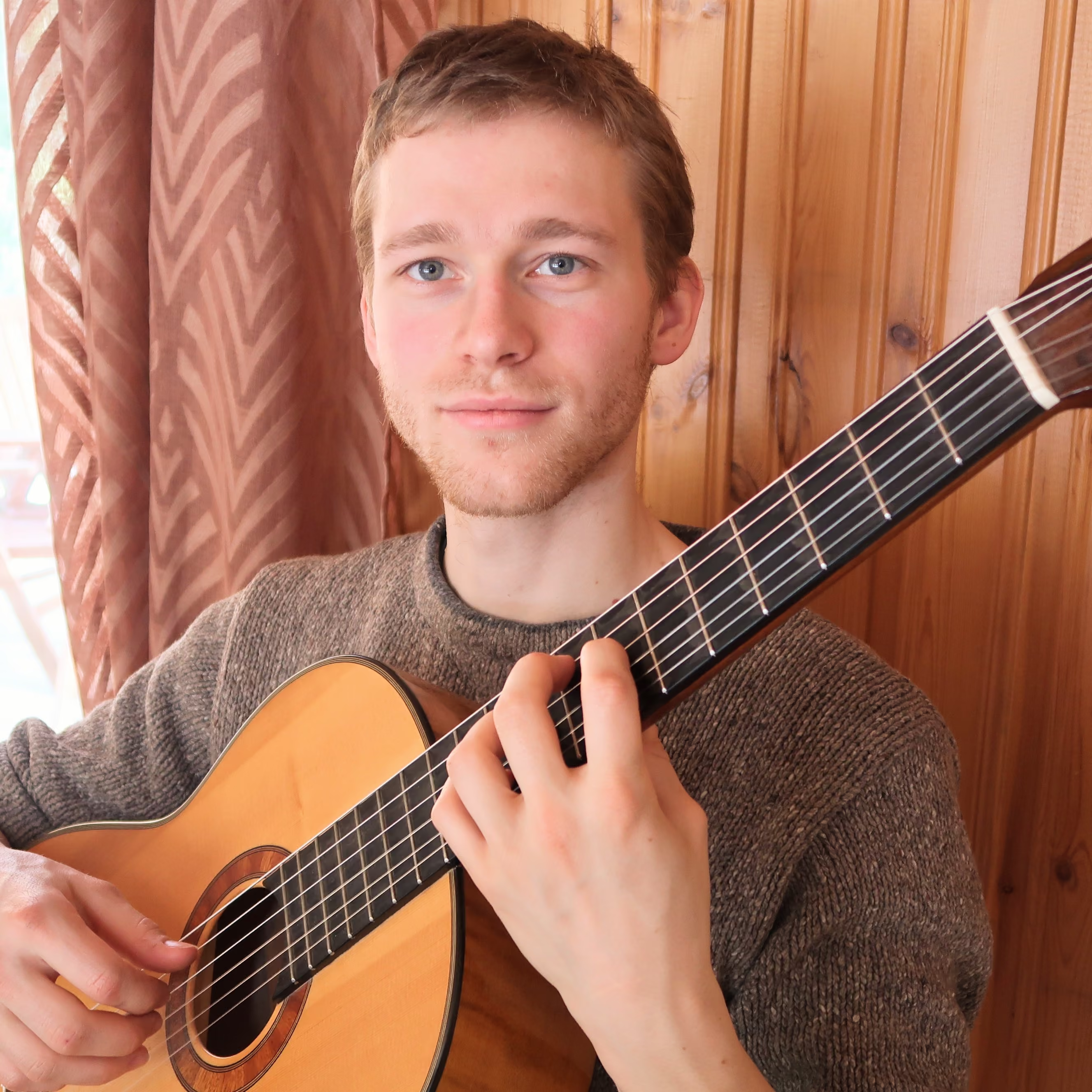
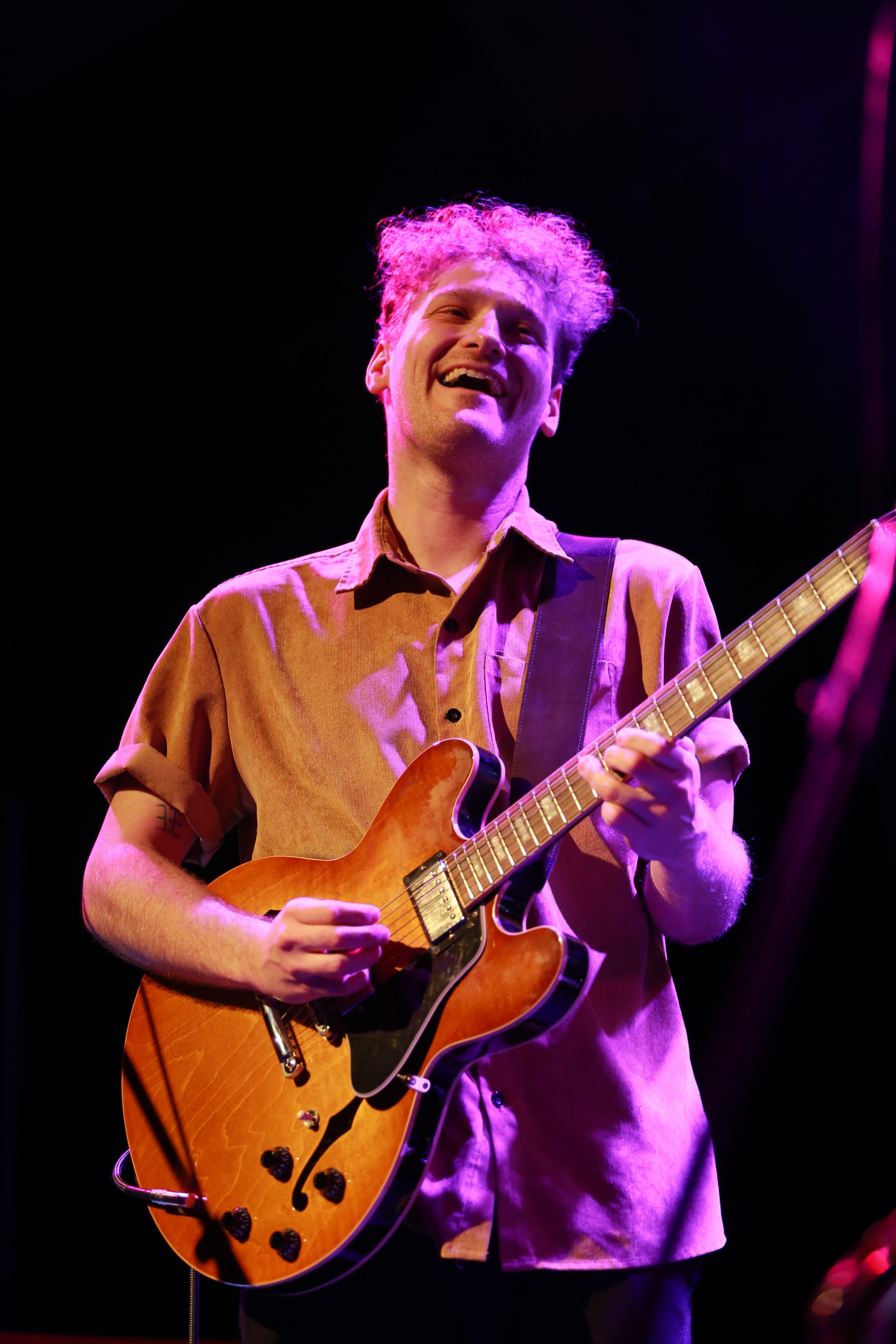
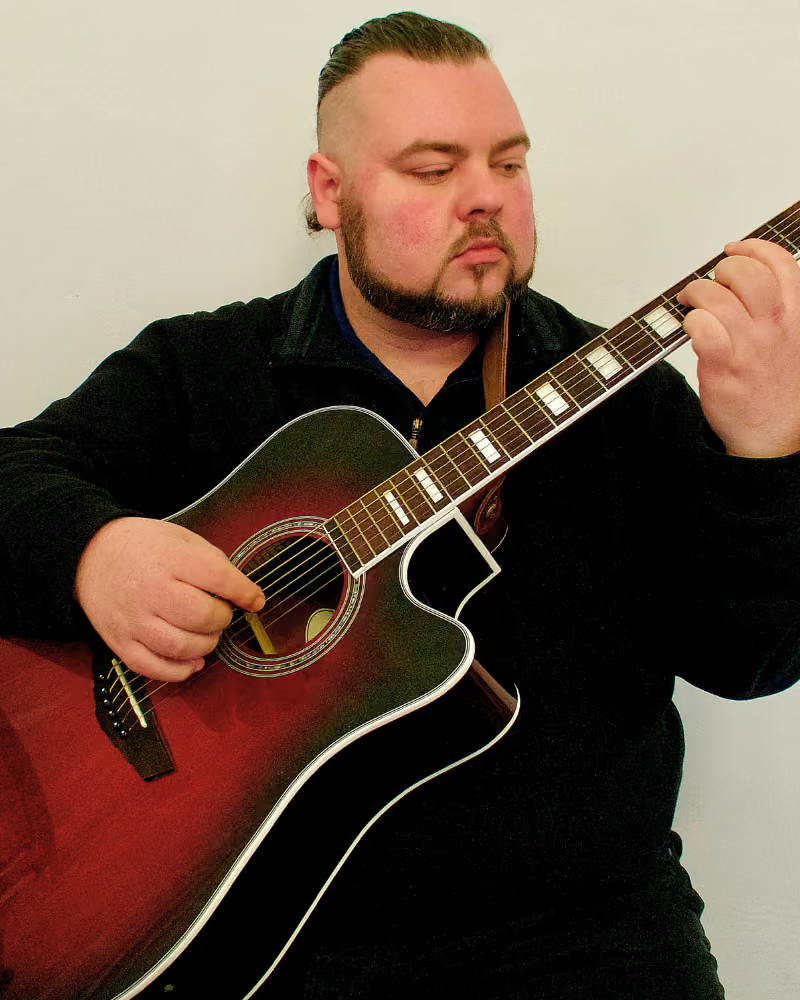


SIRIUS gives you one-to-one guitar lessons shaped around what you actually want to play, and everything from finding your teacher to payment runs through a single platform. Adding a lesson before a gig or moving a slot when the week gets busy takes a few clicks in the booking tool.
Learn the fundamentals of rhythm, chord theory and the fretboard, then apply them to the music you like, from rock and blues to pop, country, metal or fingerstyle. Acoustic or electric, your lessons always meet you at your level.
Alongside your lessons you get access to a digital Workspace built to make practice more efficient. In the SIRIUS Cloud you find the tabs, chord charts and targeted exercises your teacher assigns, all in one place. Lessons can be summarized automatically, and recordings let you go back to the moment a riff finally clicked.
You can also join monthly group sessions to play alongside other students, swap songs and pick up feedback, so you benefit from one-to-one coaching and from a community of players at the same time.

More hours = a better price per hour. Every plan: 45-min one-on-one lessons with vetted teachers.
Perfect to get started.
/hour
/hour
2 hours / month
$80.10 / month
$89.00 / month
with a 6-month membership
with a 3-month membership
↓ You save $53.40 with a 6-month plan
For lasting progress.
/hour
/hour
3 hours / month
$98.10 / month
$109.00 / month
with a 6-month membership
with a 3-month membership
↓ You save $65.40 with a 6-month plan
Faster progress, more practice.
/hour
/hour
4 hours / month
$116.10 / month
$129.00 / month
with a 6-month membership
with a 3-month membership
↓ You save $77.40 with a 6-month plan
All prices incl. VAT · Pause anytime
Many music students all over the world already trust SIRIUS.
“I've always played the same guitar chords and got much further into songwriting thanks to guitar lessons with SIRIUS”
.avif)
Louisa
guitar student
“Lisa always had to walk alone to her guitar teacher. Online guitar lessons are much more convenient.. ”
.avif)
Doro
Mother of a guitar student
“I finally really learned to play metal guitar with Robert. Power chords are just nice:)”
.avif)
steve
guitar student
“Learning guitar online quickly became boring without a teacher. Guitar lessons are super fun with Sirius.. ”
.avif)
Annika
Singing student
“I first had guitar lessons and have now started electric guitar lessons. It's great that you can easily switch... ”
.avif)
amir
Singing student
Gibt es bereits Vorerfahrungen?
Do you have any experience?
The figures below describe the local market and not what SIRIUS charges. Private teachers in Aurora and around the metro tend to quote roughly $40 to $95 for a full hour, half-hour beginner slots often land closer to $35, and anyone with a heavy performing or session background sits at the upper end. Length, studio overhead and travel all move the number, so check it with the individual teacher before you commit. At SIRIUS the rate you would pay appears before anything is booked, the opening lesson costs nothing, and no term commitment sits underneath.
Yes, and it is worth asking for. Language forms part of the match rather than an afterthought, so tell us which language you would rather think and count in and we look for that alongside style and level. It matters more than people assume: rhythm, subdivision and phrasing are far easier to absorb when nobody is translating them first. Raise it during the free trial and the match can still be adjusted if the fit is wrong.
Sight down the neck from the headstock first, because a bow or a twist is the one fault that turns a cheap instrument into an expensive one. Then press each string at the first and last frets and look for daylight, run a hand along the fingerboard edge for sharp fret ends, and on an acoustic watch for a lifting bridge or a bellied top. Electrics are simpler: listen for crackle from the jack and the pots, and confirm the truss rod actually turns. Send your teacher photos before you pay, and set aside a little for a setup, which makes an ordinary instrument dramatically easier to play.
Very little, and several things come back the other way. A camera aimed at the fingerboard shows your teacher more detail than they would catch from across a studio, and no part of your evening disappears into Parker Road or the Colfax corridor. You also stop being restricted to the few teachers who happen to work near your house in Aurora, which for anyone chasing a particular style or a particular language is the entire argument. What does genuinely differ is playing beside somebody in the same room, and the local stages exist for that once you are ready. A trial costs you nothing except the hour it takes.
Yes. Guitarists mostly trade in tablature, which tells you string and fret rather than pitch, and most people are reading it usefully after a lesson or two. Chord diagrams and a growing ear for where a song is heading cover nearly everything else you need in order to play with other people. Staff notation comes in only at the dose your goals justify, so a classical or jazz route leans on it hard while a rock or folk route barely touches it. Nobody spends a term sidelined for not sight-reading.
Gibt es bereits Vorerfahrungen?
Aurora is not a corner of Denver, whatever a quick glance at a map suggests. It is Colorado's third-most-populous city on its own terms, 386,261 residents at the 2020 census, spread over roughly 160 square miles and three counties. A place assembled that way never grows one central music district; it grows a scattering of very particular rooms, far apart, with a great many guitars sitting in the houses between them.
Begin on Havana Street. The Stampede, at 2430 South Havana, is a country-western club with a large dance floor, seven bars and a kitchen, and it teaches on its own account: line dancing on Wednesday evenings, West Coast swing on Mondays. What matters to a player is that alongside country bills the room brings in touring norteño and Latin-rock acts, so bajo sexto and requinto parts share that stage with Telecaster twang.
North of there, Stanley Marketplace at 2501 Dallas Street occupies the old Stanley Aviation factory, and its Local Drive Hangar hands local players a stage on selected evenings with no cover charge. Over on the Colfax corridor, the Aurora Fox Arts Center at 9900 East Colfax Avenue is run by the city's own Library and Cultural Services department and keeps a full season of musicals and plays running.
That is an honest inventory, and a short one for a city of nearly 400,000. Pull up concert listings for this stretch of the Front Range and most of what comes back sits west of I-225, in Denver, which is a separate city and a real drive at six in the evening.
Whatever thins out the venues thins out the teachers. The Colfax end of town and the southeastern edge past Southlands are the same municipality and nothing like the same errand, and a slot picked for proximity rather than fit is a compromise you feel every week. Distance solves a second problem too: this is one of the most linguistically mixed cities in the state, with El Salvador and Honduras both operating consulates here and the wider Denver-Aurora area home to some 30,000 Ethiopian and Eritrean residents. The odds that the nearest studio holds an instructor who plays your repertoire and speaks your language are thin, and guitar lessons in Aurora that arrive through a browser widen that pool to the entire roster.
The two hands learn separate trades. On the fretting side you start with open shapes and then spend real time on the join between them, since a chord landing half a beat late is what makes a song fall over. Barre shapes come once the hand can carry them, and they open the upper neck. The picking side is rhythm first, a wrist that keeps swinging through the beats it does not sound. Then the paths split: thumb-independent fingerstyle, alternate picking that holds together at speed, slurs and slides so a melody sounds spoken. Tablature is the currency guitarists trade in, so you get fluent there early.
All three are taught and none is the correct first choice. Steel-string acoustic is self-sufficient and builds calluses fastest. Nylon-string sits at the heart of the Latin repertoire this city listens to and forgives sore fingertips. Electric frets most easily, but arrives with a second instrument attached: an amp or an interface, gain against clean headroom, and the discovery that overdrive reproduces your mistakes as faithfully as your good ones.
A bedroom is a workshop, not a destination. The no-cover evenings in the Stanley hangar are the least intimidating place in town to try three songs in front of strangers, while the Stampede's dance floor is the opposite proposition, a moving crowd and a band paid to keep it moving.
Eight-year-olds on three-quarter-size instruments whose attention holds for half an hour. Teenagers who want one specific song and nothing else. Adults who bought an instrument at twenty-five, gave up around F, and decided two decades was long enough.
Progress holds better when it aims at something concrete, so set the target inside your own city: a run of dance-floor numbers you could play at the Stampede without watching your hands, or three songs steady enough for a hangar full of strangers at Stanley.
Bei SIRIUS kannst Du kostenlos eine Probestunde nehmen.
Die Anmeldung ist 100% kostenlos und unverbindlich.
Wir schicken Dir nach der Anmeldung Terminvorschläge für Deine gratis Probestunde.
Worauf wartest du noch?




.avif)