.avif)


Gibt es bereits Vorerfahrungen?
Do you have any experience?
Der Preis für eine Unterrichtseinheit beginnt bei 27€ und hängt von dem ausgewählten Paket ab.
We match you with a guitar teacher who fits your goals and the music you want to play, so you can start learning online with no waiting list. Right after you sign up you receive a no-obligation trial-lesson slot via WhatsApp.
After your free trial lesson you agree on goals, playing level and availability with your teacher, and your regular guitar lessons start right away.
Book your guitar lessons online whenever it suits you. The SIRIUS Workspace gives you unlimited access to exercises, chord sheets and recordings of your own sessions, so practice at home always has a clear direction.
SIRIUS pairs you with a guitar teacher in Atlanta who matches your playing level, your schedule and the music you actually listen to. Tell us whether you are starting from zero, dusting off an instrument you already own or trying to push past a plateau, and we take it from there. Every teacher on the platform is vetted before a single student is assigned. Sign up for the free trial lesson and you receive a session proposal with a matching teacher.
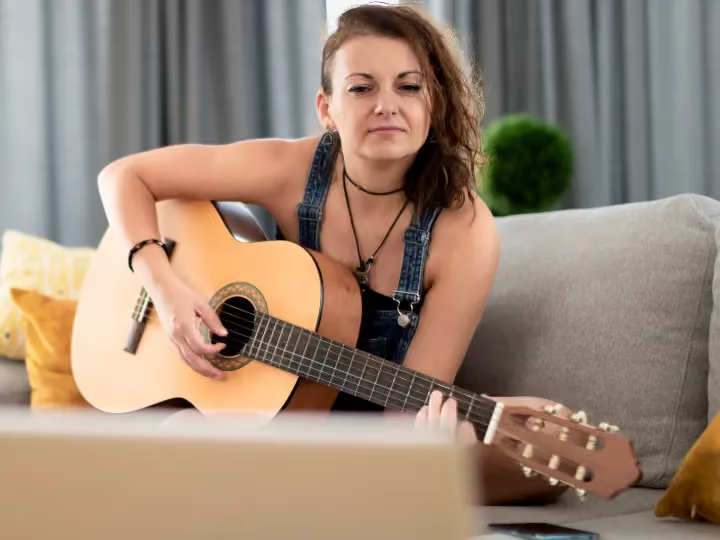
The lessons run on technology built for music instruction, so the audio stays clean enough to hear pick attack and string noise, and there is nothing to download or install. You join from a laptop, tablet or phone anywhere in Atlanta, and your teacher can watch your hands as well as hear them. Between sessions the Workspace holds your tabs, exercises and lesson recordings, so your progress does not depend on memory. It is one-to-one attention without the crosstown drive.





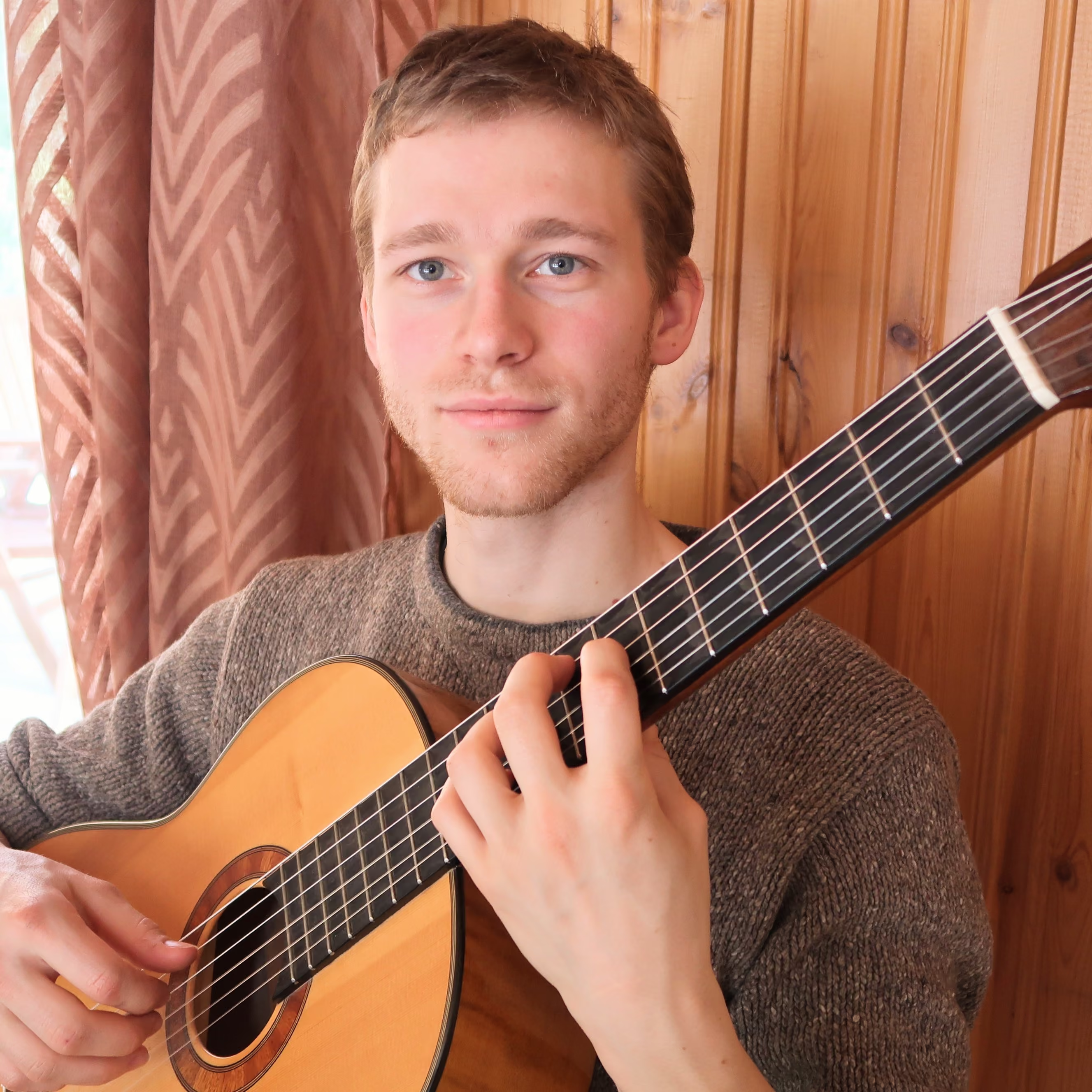
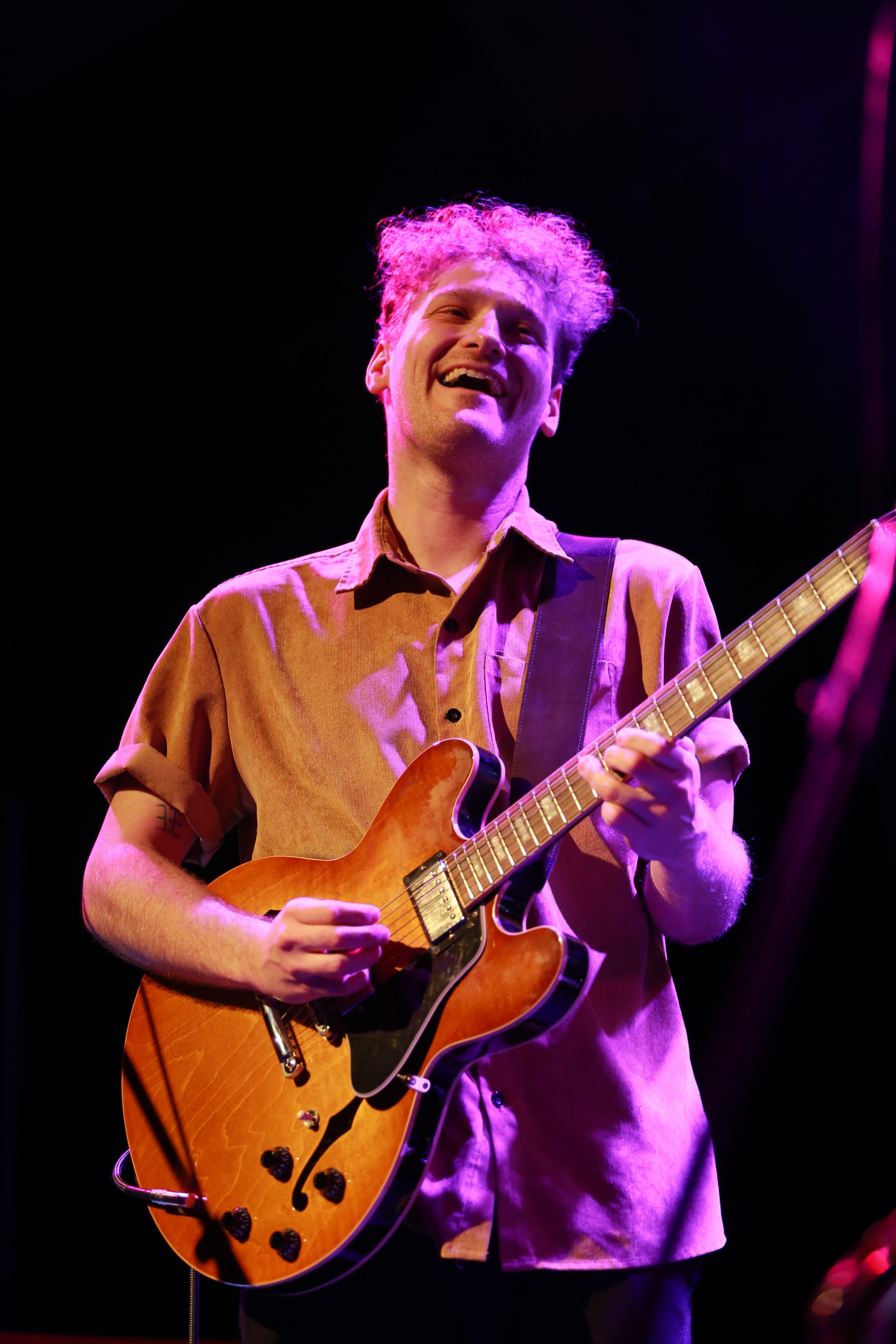
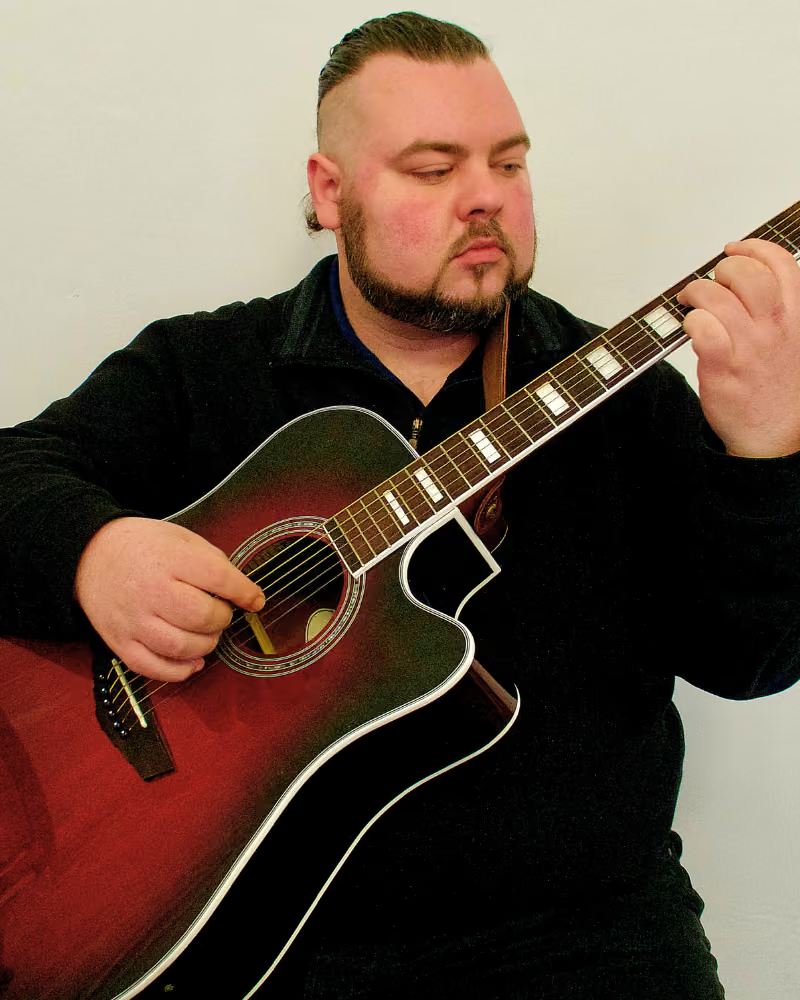


SIRIUS gives you one-to-one guitar lessons shaped around what you actually want to play, and everything from finding your teacher to payment runs through a single platform. Adding a lesson before a gig or moving a slot when the week gets busy takes a few clicks in the booking tool.
Learn the fundamentals of rhythm, chord theory and the fretboard, then apply them to the music you like, from rock and blues to pop, country, metal or fingerstyle. Acoustic or electric, your lessons always meet you at your level.
Alongside your lessons you get access to a digital Workspace built to make practice more efficient. In the SIRIUS Cloud you find the tabs, chord charts and targeted exercises your teacher assigns, all in one place. Lessons can be summarized automatically, and recordings let you go back to the moment a riff finally clicked.
You can also join monthly group sessions to play alongside other students, swap songs and pick up feedback, so you benefit from one-to-one coaching and from a community of players at the same time.

More hours = a better price per hour. Every plan: 45-min one-on-one lessons with vetted teachers.
Perfect to get started.
/hour
/hour
2 hours / month
$80.10 / month
$89.00 / month
with a 6-month membership
with a 3-month membership
↓ You save $53.40 with a 6-month plan
For lasting progress.
/hour
/hour
3 hours / month
$98.10 / month
$109.00 / month
with a 6-month membership
with a 3-month membership
↓ You save $65.40 with a 6-month plan
Faster progress, more practice.
/hour
/hour
4 hours / month
$116.10 / month
$129.00 / month
with a 6-month membership
with a 3-month membership
↓ You save $77.40 with a 6-month plan
All prices incl. VAT · Pause anytime
Many music students all over the world already trust SIRIUS.
“I've always played the same guitar chords and got much further into songwriting thanks to guitar lessons with SIRIUS”
.avif)
Louisa
guitar student
“Lisa always had to walk alone to her guitar teacher. Online guitar lessons are much more convenient.. ”
.avif)
Doro
Mother of a guitar student
“I finally really learned to play metal guitar with Robert. Power chords are just nice:)”
.avif)
steve
guitar student
“Learning guitar online quickly became boring without a teacher. Guitar lessons are super fun with Sirius.. ”
.avif)
Annika
Singing student
“I first had guitar lessons and have now started electric guitar lessons. It's great that you can easily switch... ”
.avif)
amir
Singing student
Gibt es bereits Vorerfahrungen?
Do you have any experience?
Private teachers around Atlanta generally advertise somewhere between $40 and $90 an hour, with shorter 30 minute slots for younger students at the lower end of that. Those are local market figures collected from Atlanta lesson directories, not SIRIUS prices. With SIRIUS you learn online and you see your rate before anything is booked, your first session is a free trial, and there is no long-term contract attached to it.
Most beginners get through a simple two or three chord song within a few weeks of steady practice. The bottleneck is almost never the chords themselves, it is switching between them in time, which is exactly what a teacher fixes early. Ten focused minutes a day beats one long session on Sunday. After three to six months of weekly lessons most students have a handful of songs, a usable strumming vocabulary and the first barre chords under their fingers.
Yes, you need an instrument of your own, because most of the progress happens in the practice you do between sessions. It does not have to be expensive: a decent entry-level acoustic or electric will carry you through the first year or two, and Atlanta shops such as Maple Street Guitars in Buckhead stock used instruments and can set one up so it plays comfortably. If something is already sitting in a closet at home, bring it to your trial lesson and your teacher will tell you whether it is worth a setup.
Yes, and in a metro this spread out it is often the more realistic option. On video your teacher can watch your fretting hand and your picking hand up close, sometimes closer than from across a room, and the audio is built for music rather than conference calls. You skip the drive on I-285 or the Connector, you keep your slot when a thunderstorm rolls in, and you still get undivided one-to-one attention. Plenty of students in Atlanta pair online lessons with local jams and open stages.
Start with whichever one makes you want to pick it up. Acoustic needs no amp or cable and builds finger strength fast, though the strings are harder on your fingertips in the first weeks. Electric has lighter strings and a slimmer neck, which many beginners find easier, but it adds an amp and a few settings to learn. If riff-driven rock or metal is what you love, start electric; if it is singer-songwriter material, start acoustic. Your teacher works with either, and switching later is not starting over.
Gibt es bereits Vorerfahrungen?
Atlanta has never been a one-genre town, and its guitar history shows it. Mastodon came together here in 2000, after Bill Kelliher and Brann Dailor moved down from Rochester and met Brent Hinds and Troy Sanders weeks later. Blackberry Smoke started in the same city the same year and built a Southern rock catalog out of it. Add the blues that still runs seven nights a week on Howell Mill Road and the indie rooms of East Atlanta Village, and a guitar here is a working tool, not a wall decoration.
The reasons to start are easy to walk into. Northside Tavern at 1058 Howell Mill Road NW has live blues every night of the week, no cover on weeknights, and a Monday jam where the house band invites people to bring an instrument and step up. The EARL on Flat Shoals Avenue and 529, a few doors down, keep local bills running most nights. Variety Playhouse in Little Five Points books straight guitar nights alongside its touring calendar, with Tommy Emmanuel in December 2026 and Leo Kottke in January 2027. Every fall Shaky Knees takes over Piedmont Park; the 2026 edition runs September 18 to 20.
Then there is the practical side. Most people looking for guitar lessons in Atlanta are not short on teachers, they are short on a reliable hour in the week. The city is spread wide, and an instructor who looks close on a map can be a forty minute crawl away once the Connector or I-285 seizes up. Add summer afternoon thunderstorms and shift work at the airport and the hospitals, and it is the drive across town that ends the lessons, not the music. Learning from home removes the drive and keeps the teacher, so the same slot holds each week whether you live in Kirkwood, Grant Park or out toward the west side.
The first weeks are about the shapes that unlock the most songs: open chords, then changing between them cleanly enough that the strumming hand never stops. Rhythm and timing come next, because that is what separates a beginner from a player. From there you build alternate picking for speed and evenness, barre chords so the whole neck opens up, and fingerpicking for quieter material. Hammer-ons and pull-offs give your lines shape without extra pick attacks. You will read tab, plus enough standard notation to talk with musicians who never use it.
Both are taught, and neither is the default correct answer. Acoustic builds hand strength and leaves nothing to hide behind. Electric is kinder to the fingertips, has a slimmer neck and gets you into riff territory sooner, which matters if a Mastodon record started this. Go electric and your teacher treats the amp as an instrument too, so gain, EQ and volume stop being guesswork, then works through the pedals that follow, usually overdrive, reverb and delay before anything fancier.
Beyond those rooms, Terminal West in West Midtown has shows booked through December, and Smith's Olde Bar on Piedmont Avenue fills its calendar into November. When the instrument needs attention, Maple Street Guitars in Buckhead has been selling and repairing since 1981 with technicians on site, and Intown Guitar Repair in Morningside handles setups and fretwork. That infrastructure is the point: you work the material through with your teacher at home, then carry it to a Monday jam, a friend's basement or an open stage.
Kids usually begin around seven or eight, once hands fit a three-quarter size instrument, and they do best on songs they already know. Adults who have never touched a fretboard underestimate how fast three chords become a real song. Returners with a guitar in the closet since college often move quickest, because the muscle memory is still filed away.
A trial session is the cheapest way to find out whether this sticks. Tell us the songs you have in mind, we match you with a teacher, and you judge the fit after an hour, not after a contract. The first lesson costs nothing; the rest is practice.
Bei SIRIUS kannst Du kostenlos eine Probestunde nehmen.
Die Anmeldung ist 100% kostenlos und unverbindlich.
Wir schicken Dir nach der Anmeldung Terminvorschläge für Deine gratis Probestunde.
Worauf wartest du noch?




.avif)