
.avif)


Do you have any experience?
We match you with the perfect vocal coach for your goals, so you can learn to sing conveniently online - singing lessons with no waiting time. Right after signing up you get a no-obligation trial-lesson slot via WhatsApp.
After your free trial lesson, discuss your goals and availability with your vocal coach and start learning to sing right away.
Book your singing lessons flexibly online. In the SIRIUS Workspace you get unlimited access to vocal exercises outside your lessons, so you can keep practicing at home with our tools.
Want to learn to sing and looking for a vocal coach in San Luis, Arizona? We work with SIRIUS-vetted vocal coaches. Based on your needs we match you with the perfect vocal coach - whether you are just starting to sing or looking for singing lessons for adults or kids. Want to work on your intonation, improve your head voice or explore breath training? Sign up for our free trial lesson and get a session proposal with your perfect vocal coach.
Our experienced vocal coaches help you unlock your full potential. Our technology, built for online singing lessons, guarantees excellent sound quality and lets you learn to sing from anywhere - with no extra software or download.


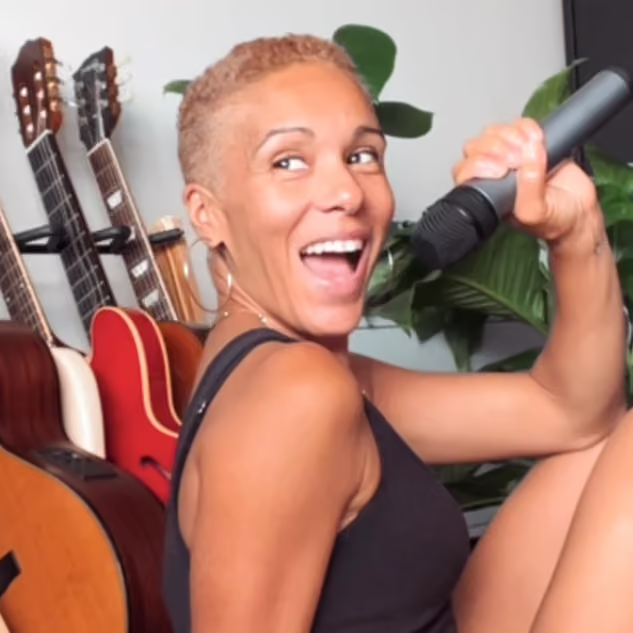




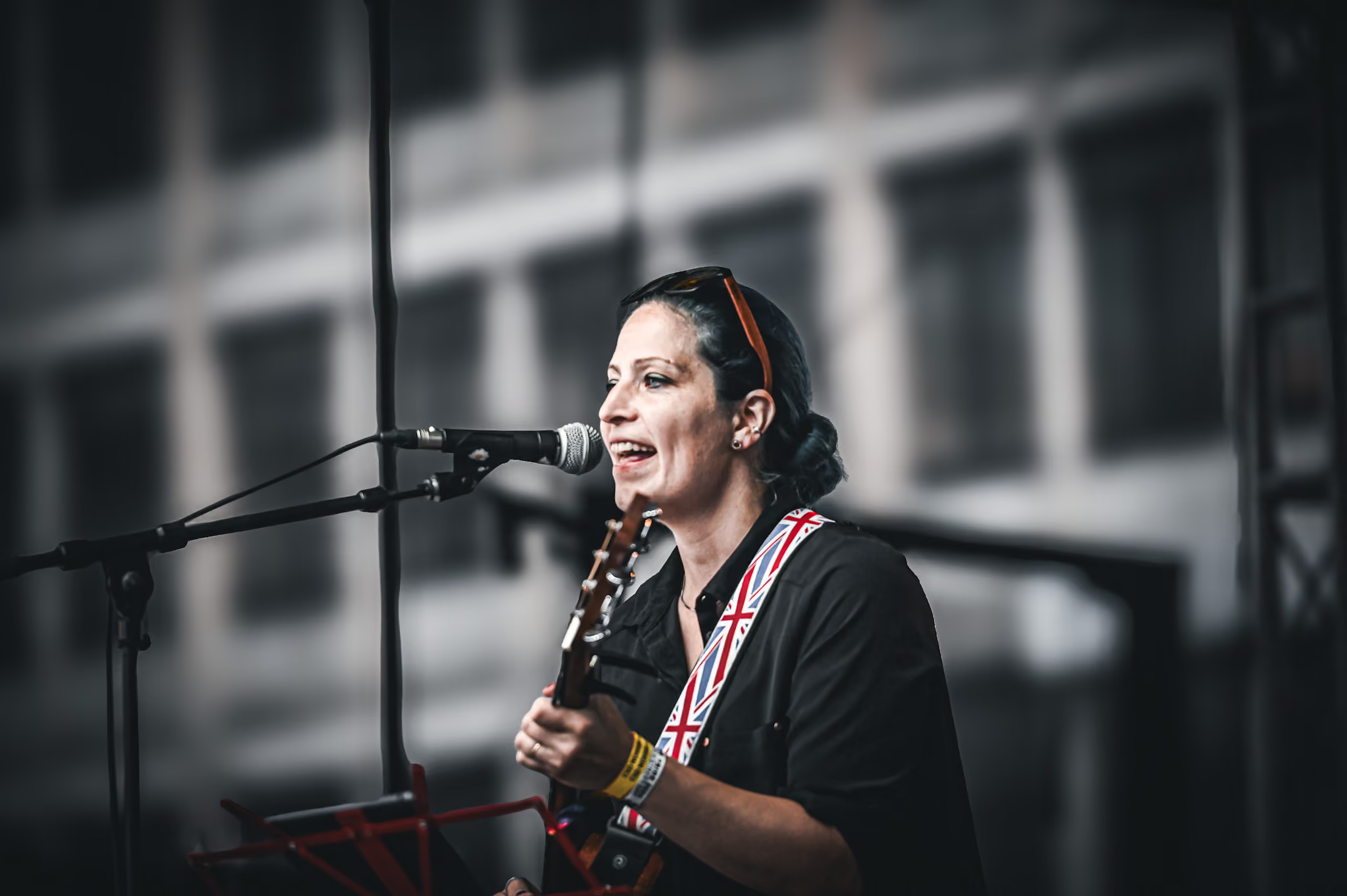



SIRIUS gives you personal singing lessons tailored to your needs - from finding a coach to payment, everything runs smoothly through our platform. Whether you want to add lessons or reschedule, it all works effortlessly online through our booking tool. You can even rent a keyboard to accompany yourself while you sing.
Learn the fundamentals of music theory, expand your vocal range and develop your sense of intonation - whether you want to sing pop, jazz, opera, rock or metal. These voice lessons and vocal lessons always meet you at your level.
SIRIUS gives you not only professional singing lessons but exclusive access to a digital Workspace that makes learning to sing more efficient and structured. In the SIRIUS Cloud you find all key materials and targeted vocal exercises from your vocal coach - available anytime in one place. Lessons can be summarized automatically, and you can access recordings of your sessions to track progress and work on your vocal technique.
Alongside one-on-one lessons you can join monthly group sessions to connect with other singers, try new vocal exercises and get valuable feedback - so you benefit from individual coaching and the energy of the community.

More hours = a better price per hour. Every plan: 45-min one-on-one lessons with vetted teachers.
Perfect to get started.
/hour
/hour
2 hours / month
$80.10 / month
$89.00 / month
with a 6-month membership
with a 3-month membership
↓ You save $53.40 with a 6-month plan
For lasting progress.
/hour
/hour
3 hours / month
$98.10 / month
$109.00 / month
with a 6-month membership
with a 3-month membership
↓ You save $65.40 with a 6-month plan
Faster progress, more practice.
/hour
/hour
4 hours / month
$116.10 / month
$129.00 / month
with a 6-month membership
with a 3-month membership
↓ You save $77.40 with a 6-month plan
All prices incl. VAT · Pause anytime
Do you have any experience?
Many music students worldwide already trust SIRIUS.
“Maya is very friendly and competent. The singing lessons are great! ”
.avif)
Lily
Singing student
“I've been studying singing with Jessica for 8 months now and I'm still having fun:)”
.avif)
Maria
Singing student
“Self-learning videos for learning to sing were not my thing. But since I discovered singing lessons with Lena about Sirius, I've been fully motivated.”
.avif)
Georgina
Singing student
“I'm taking singing lessons for the first time and I just love Sirius. I've received a lot of valuable tips from Habib. I really recommend it to you guys.”

Lucas
Singing student
“Lena not only knows about singing lessons, but also makes the lesson a real experience. It is always my highlight of the week.”
.avif)
Carl
Singing student
<p>The city bills its two music classes by the month and holds them at the Senior Center on two fixed evenings. We sell the single hour instead: tuition begins at $29. An introductory lesson costs nothing, so the first session is a genuine hour with a genuine coach and not a sales pitch. Session length and how often you book adjust the figure from there.</p>
<p>The sentence is nearly always narrower than it sounds, and the city's own course list shows why. Press a key on a piano and the pitch is correct before you have done anything; pluck a fretted string and the same holds. A beginner at either instrument sounds approximately right on the first evening, and the difficulties stay hidden inside the machine. A voice has no such machine, so everything it does badly is audible from the first note - which feels like proof of inability and is really just an absence of frets.</p>
<p>The city's poster sets a floor and no ceiling: 6+ for piano, 8+ for guitar. Singing behaves the same way, and its floor is lower still, since matching pitch to a tune is something very small children do for pleasure. Above that floor the only variable is what the body is doing at the time - growing, remaking itself through adolescence, or long settled with habits attached. The plan gets built for whichever of those turns up.</p>
<p>The city's fall term runs from August to a single printed end date, December 16, 2026. That is roughly the span in which a weekly hour produces something you can hear without being told about it. Push past one such term and the slower structural work starts to land. Nothing about a voice finishes on a printed date, which is the one respect in which it differs from a course.</p>
<p>Very well, and for this instrument better than for most. Guitar and piano want a shared room because hands have to be watched. Nothing about a voice needs watching in the same way; it needs hearing, and hearing closely. A microphone at conversational distance delivers more detail to a coach than the far side of a classroom ever does. The exchange runs quickly - a line, a correction aimed at one syllable, the same line again - and the file remains in your workspace once the hour closes.</p>
Do you have any experience?
The city's fall course poster lists ten classes and codes them with two letters. CC stands for the Cesar Chavez Cultural Center at 1015 N. Main St. SC stands for the Senior Center at 790 E. Cesar Chavez Blvd. Zumba, folkloric, ballet, gymnastics, modern dance, art and jiu-jitsu carry CC. Guitar and piano carry SC. The two music classes the city runs are the two that happen somewhere other than the building it calls its home for the arts. Whoever learns an instrument from the City of San Luis walks to a different door than everybody else on the list.
The two classes at that other address sit back to back on the same two evenings. Guitar runs Monday and Thursday from 6:00 to 7:00 p.m. at $35 a month; piano follows from 7:00 to 8:00 p.m. at $30 a month, and the poster names the same instructor, Damian, for both. Guitar is marked 8+, piano 6+. Two hours, one teacher, two instruments with keys and strings you can point at. A voice has no frets to point at, which is what makes it awkward to teach in a room set up for something else.
One instructor covering guitar at six and piano at seven is teaching two instruments where the pitch is already decided by the instrument. Press a key, get the note. With singing the mechanism producing the pitch sits inside the person, invisible from outside. A listener can only hear the result and work backward from it. Reverse engineering of that kind needs an undivided hour - somebody naming the exact syllable where support drops away, then handing you a method for holding it.
Tone comes first in this order, because it is what a listener registers before anything else and what a beginner most wants to change. Breath sits under it as the supply. Then tuning, held steady without an instrument beside you to lean on - the difference between a voice and a piano, where the pitch arrives ready-made. Then stamina, enough for a long evening. The register crossing comes last, because it is the slowest to shift and the most rewarding when it does. Reading music enters wherever your repertoire calls for it, in whichever language you are singing.
The city's music classes are billed by the month and tie you to a fixed pair of evenings at a fixed address. Real value, honestly arranged. What it does not buy is an hour pointed at one person. Ours is billed by the hour: tuition begins at $29, purchased singly, with a coach selected for the songs on your own list and sessions you move yourself when the week demands. An introductory lesson costs nothing, so you weigh the arrangement before a cent changes hands.
A guitar student photographs a chord shape and checks it at home. A piano student looks down and sees which key went wrong. A singer has had no equivalent, and the recording is what closes that gap. Monday's hour keeps its evidence: the line you got right on the fourth try sits beside the three that failed, and the improvement is something you verify for yourself. We built the audio path around sung sound, which means the soft entries and the ends of phrases reach the file intact.
The parish at 984 N. Main St., St Jude Thaddeus, publishes its whole week in Spanish and distinguishes carefully between kinds of gathering: Tuesday is a Servicio de la Palabra at 6:00 p.m., a service of the word without a priest, while Wednesday through Saturday carry a Misa at 6:00 p.m. Sunday runs four - 8:00 a.m., 11:00 a.m., 1:00 p.m. and 7:00 p.m. At the high school on North 8th Avenue, mariachi appears in the club list rather than the course catalog, sponsored by the same teacher who carries band.
The city's own poster puts an age on each class, and the two music classes are among those with a floor and no ceiling: guitar at 8+, piano at 6+. Nothing above those numbers is specified. Singing behaves the same way. A small child manages short sessions on tunes already familiar. A teenager whose range is moving needs the shift planned for. An adult beginning at fifty is doing straightforward work, not remedial work. Lessons here start from whichever voice arrives, without a class number or a minimum age attached.
"Monday and Thursday, 6:00 to 7:00 p.m." asks a good deal of a household. Two fixed evenings, a trip to 790 E. Cesar Chavez Blvd. and back, and a course that ends on a date the poster prints in capitals: Wednesday, December 16, 2026. The library on North 6th Avenue is similarly shaped - open Tuesday through Thursday until 7:00 p.m., Friday and Saturday until 5:00 p.m., closed Monday and Sunday. Both of those have a fixed door and fixed hours. An online lesson has an hour and no door.
The first hour wants a song you already know. The parish prints its whole week in Spanish; the city prints its course poster in English. None of that has to be settled before a lesson starts, because the choice of song belongs to the singer and not to the room. Bring a hymn, something from your phone, a piece learned in childhood. It gets heard through once without interruption, then once more with a single instruction attached. No registration fee, no monthly commitment, no drive across town.
San Luis puts its guitar and piano at the Senior Center on Cesar Chavez Boulevard and the rest of the list at the Cultural Center on Main Street. Two addresses, and either one asks you to arrive somewhere at a set time on a set evening. A voice is different equipment: it arrives wherever you are, and the hour that trains it can arrive there too. The city has built rooms for its music. Yours can begin at a kitchen table, in whichever language you sing.



.avif)
.avif)
